



Meta Description: Discover Wolchulsan in Korea with scenic peaks, trails, temples, ecology, and cultural heritage in one essential travel guide.
Korea’s National Parks and the Charm of Natural Geography
Korea is known for its mountainous landscape, with a large part of the country made up of mountains and valleys. Because of these geographical features, Korea has many national parks, and each region presents its own distinct natural scenery and ecosystem. In addition to well-known national parks such as Seoraksan, Jirisan, and Hallasan, the southern region of Korea also has many beautiful mountains. In particular, the mountains of Jeollanam-do are not always extremely high, but they are highly valued for their unusual rock formations and rich historical and cultural heritage. Among them, Wolchulsan is especially famous for its dramatic rocky scenery and is often called the “Geumgang of Honam.”
• Korea has a landscape with many mountains
• National parks are distributed across the country
• Natural scenery and historical heritage coexist
• Wolchulsan is a representative mountain of the southern region
Location and Basic Overview of the national park
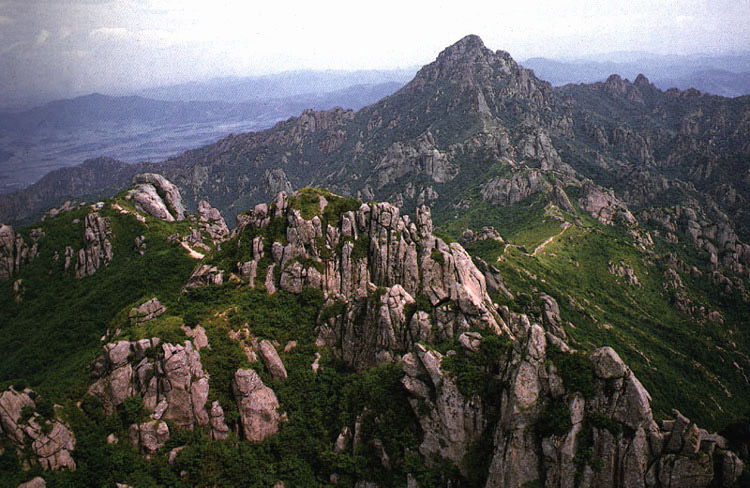
Wolchulsan is located on the border of Yeongam-gun and Gangjin-gun in Jeollanam-do. From this mountain, you can look east toward Jangheung, west toward Haenam, and south toward Wando and the Dadohae area. Because it rises sharply out of the surrounding plain, Wolchulsan is easy to recognize even from a distance, and it is famous for its steep rocky landscape. The highest peak of Wolchulsan is Cheonhwangbong at about 810 meters, and major peaks such as Gujeongbong, Sajabong, Dogapbong, and Jujibong form a continuous ridgeline from east to west. Most of these peaks are made of granite and have developed their distinctive appearance through long periods of weathering and erosion.
• Location: border of Yeongam-gun and Gangjin-gun, Jeollanam-do
• Highest peak: Cheonhwangbong, about 810m
• Main peaks: Gujeongbong, Sajabong, Dogapbong, Jujibong
• Feature: dramatic granite rock formations
Wolchulsan in History and Literature
This national parkhas long inspired poets and writers because of its beautiful scenery. During the Goryeo period, the poet Kim Geuk-gi praised the mysterious landscape of Wolchulsan and expressed its natural harmony in poetry. In the Joseon period, Kim Si-seup also wrote of Wolchulsan, describing the magnificent beauty of the southern landscape. Historical records note that in the Silla period the mountain was called Wollasan, and in the Goryeo period it was called Wolsaengsan. These names are understood to have come from the meaning of a mountain where the moon rises.
• Called Wollasan in the Silla period
• Called Wolsaengsan in the Goryeo period
• Praised by many literary figures
• Associated with the image of the rising moon
The Unique Natural Terrain of Wolchulsan
The national park is a residual mountain mass that rises suddenly from the broad Naju plain. The entire mountain looks like a giant exhibition hall of stone, with unusual rock formations and cliffs spread across its slopes. Because of this remarkable topography, Wolchulsan is also called the “Geumgang of Honam.” It was formed where the Sobaek mountain range, branching from the Taebaek range, extends southwestward and then rises prominently near the southwestern coast. Countless rock peaks and cliffs create a dramatic natural scene. The mountain is also famous as a photography destination because of its spectacular sunrise, moonrise, and sunset views.
• Known as the “Geumgang of Honam”
• Many strange rock formations and cliffs
• Distinctive residual mountain terrain
• Famous for sunrise, moonrise, and sunset scenery
Ecology and Natural Environment of Wolchulsan
Although Wolchulsan has many exposed rocky areas and steep valleys with limited water flow, it remains an ecologically important region with around 700 plant species and more than 800 animal species. It is especially significant because warm-temperate and temperate forest zones overlap here. Two representative flagship species of the area are the sundew and the Reeve’s turtle, and restoration projects for protected species have also been carried out. Rare birds such as the Chinese sparrowhawk, kestrel, owl, and scops owl are also known to inhabit this region.
• About 700 plant species
• About 800 animal species
• Representative species: sundew and Reeve’s turtle
• Habitat for rare bird species
Designation and Development of Wolchulsan National Park
Wolchulsan was first designated as a provincial park in 1973 because of its scenic value. Later, as its ecological and natural importance was more widely recognized, it was elevated to national park status in 1988. Since becoming a national park, it has been more systematically managed and protected, and it has grown into one of the 대표 natural tourist destinations of southern Korea. In the same year, a management office was established to oversee visitor services and nature conservation.
• Designated as a provincial park in 1973
• Promoted to national park status in 1988
• National park management office established
• Systematic conservation and visitor management
Cultural Heritage and Temples of Wolchulsan
Wolchulsan is not only known for its natural beauty but also for its rich historical and cultural heritage. One of its best-known treasures is the Wolchulsan Rock-carved Seated Buddha, which is designated as a National Treasure and carved into a cliff face. Dogapsa and Muwisa, two temples with more than a thousand years of history, are also major cultural landmarks of Wolchulsan. Dogapsa is known as a temple founded by Doseon Guksa, who is associated with the spread of geomantic thought in Korea, and it preserves many valuable cultural properties.
• National Treasure: Wolchulsan Rock-carved Seated Buddha
• Temples: Dogapsa and Muwisa
• Historical site related to Wangin Doctor nearby
• Strong historical and cultural tourism value
Hiking Trails and the Famous Cloud Bridge of Wolchulsan
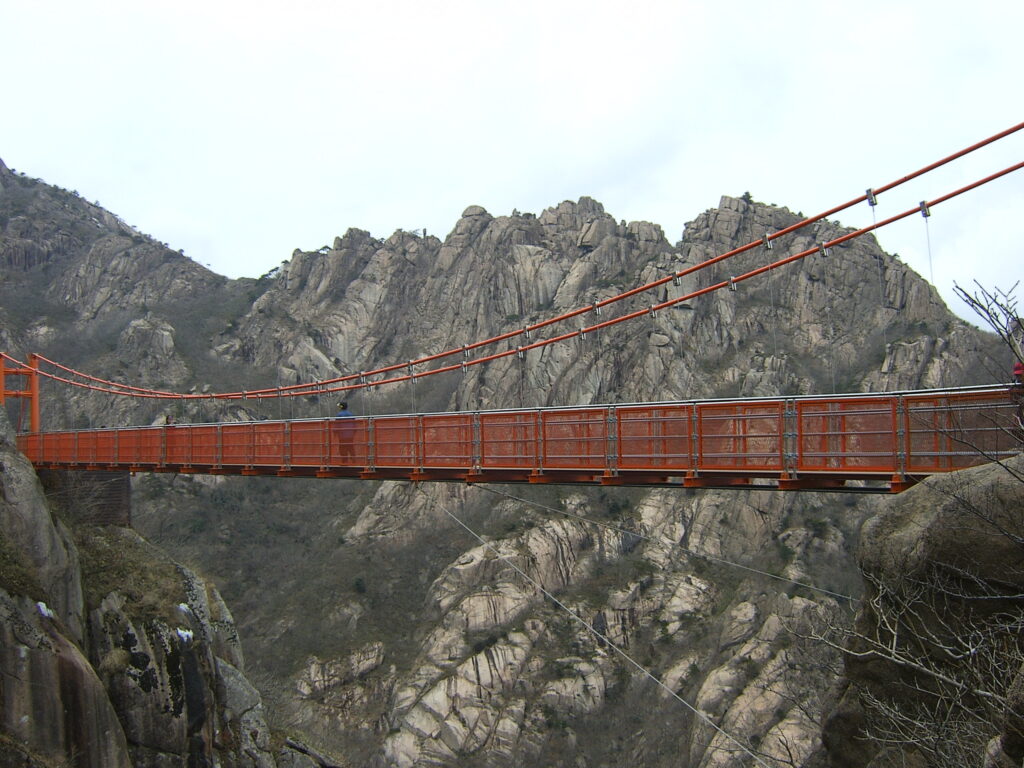
Wolchulsan National Park has six designated hiking courses, offering a range of options for both hikers and general visitors. One of the best-known attractions is the Cloud Bridge connecting Maebong and Sajabong. This suspension bridge is widely recognized as one of the symbolic sights of Wolchulsan. The nine pools on Gujeongbong and the silver grass fields of Miwangjae are also famous scenic highlights that many visitors seek out during their trip.
• Six official hiking courses
• Cloud Bridge as a signature attraction
• Nine pools of Gujeongbong
• Miwangjae silver grass field
Location and Transportation Information for Wolchulsan
Wolchulsan is located between Yeongam-gun and Gangjin-gun in Jeollanam-do, and many visitors reach it by car. Major trailheads are near Dogapsa and Cheonhwangsa, and the mountain can also be accessed by bus from nearby cities. The national park visitor center provides information on hiking routes and nature interpretation programs.
• Location: border of Yeongam-gun and Gangjin-gun, Jeollanam-do
• Main trail entrances: Dogapsa and Cheonhwangsa
• Transportation: bus or car access
• Visitor center provides route guidance
• Google Map
Kosmedi Services for Easier Travel in Korea
While traveling in Korea, there may be times when you need not only sightseeing information but also hospital visits or medical consultation. Kosmedi provides hospital information verified by Korean locals and introduces hospitals where interpretation services are available for foreign visitors. You can also check hospital procedure events, tourist attraction information, reviews, and introductions in one place, which is helpful for travelers who need both travel and medical information. Kosmedi also offers discount coupons and event benefits, and real-time messaging consultation makes it easier to get quick answers to your questions. In addition to hospital information, Kosmedi provides useful details on restaurants, festivals, events, discounts, popular places, and local hidden gems across Korea.
• Verified hospital information in Korea
• Guidance to hospitals with interpretation services
• Hospital events and discount coupons available
• Real-time messaging consultation
• Information on restaurants, festivals, events, and local attractions

