


National Folk Museum of Korea Official Website (Eng/中文/日本語)
Discover Traditional Korean Life at the National Folk Museum of Korea
Korean tradition can be understood not only through royal palaces and court culture, but also through the way people dressed, ate, lived, worked, celebrated, and spent their free time. Clothing, food, housing, farming, markets, weddings, games, and music all reveal how everyday life has shaped Korean culture over generations.
Located in the Gyeongbokgung area of Seoul, the National Folk Museum of Korea is one of the country’s leading cultural institutions for collecting, researching, preserving, and exhibiting materials related to Korean folk life and everyday culture. Travelers who want to understand not only royal history but also how ordinary Koreans actually lived can easily combine a visit to the National Folk Museum of Korea with a Gyeongbokgung Palace itinerary.
One of the biggest advantages is that admission to the National Folk Museum of Korea is free, making it one of the most accessible places in central Seoul to experience traditional Korean culture without an additional admission cost.
• Museum dedicated to Korean everyday life and folk culture
• Located in the Gyeongbokgung area of Seoul
• Free admission
• Covers Korean clothing, food, housing, work, and daily life
• Easy to combine with a visit to Gyeongbokgung Palace
• Recommended for international visitors interested in Korean culture
What Is the National Folk Museum of Korea?
The National Folk Museum of Korea is a cultural institution that preserves and studies social and cultural materials related to Korean people, Korean society, and Korean culture. Its major functions include collecting folk materials, organizing exhibitions, conducting research, and providing public education.
Among these roles, the collection and preservation of rapidly disappearing materials from everyday life are especially important. Unlike archaeological artifacts or fine art objects, folk materials are directly connected to the ordinary lives of people in the past. Household tools, clothing, farming equipment, documents, and food-related objects were once common parts of everyday life but can quickly disappear as lifestyles change.
For this reason, the National Folk Museum of Korea has collected folk materials through purchases, donations, deposits, and other methods. According to the museum information provided, its collection had reached 131,140 objects as of October 2017.
• Collection of Korean folk materials
• Exhibitions and academic research
• Public education
• Preservation of rapidly disappearing everyday culture
• Materials collected through purchase, donation, deposit, and other methods
• 131,140 objects in the collection as of October 2017
Collections Showing Korean Clothing, Food, Housing, and Daily Life
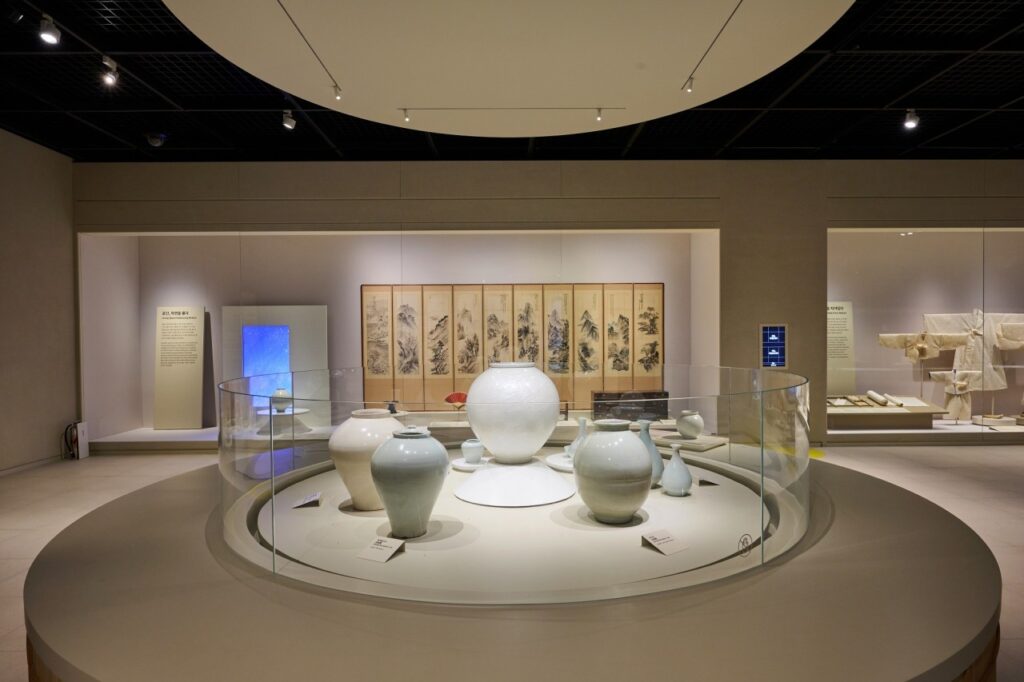
The National Folk Museum of Korea presents itself as Korea’s representative museum of folk life history, and most of its collections are closely connected to how Korean people actually lived.
Examples include a wooden kimchi jar collected during field research in a mountain village in Gangwon Province, a skirt and jeogori worn by a bride when entering her new family, clothing excavated from a Joseon-period tomb, agricultural tools used in farming, and old documents recording private land transactions.
These objects are managed according to their practical uses and are broadly classified into categories such as clothing, food, housing, agriculture, and commerce. Exploring these collections at the National Folk Museum of Korea therefore offers more than a look at old objects—it helps visitors understand how people lived and worked in earlier periods of Korean history.
• Clothing-related artifacts
• Food and dining culture materials
• Housing and household objects
• Agricultural and occupational materials
• Commerce and trade records
• Kimchi jars, traditional clothing, farming tools, and historical documents
Korean Life from Birth and Marriage to Games and Music
The collections of the National Folk Museum of Korea are not limited to food, clothing, and housing. The museum also preserves objects connected with major stages of human life, including birth, childhood, marriage, social advancement, and death.
Leisure and community culture are also important themes. Visitors can encounter materials related to games, personal tastes, traditional entertainment, music, and other forms of recreation enjoyed in Korean society. The museum also holds military-related objects such as swords, bows, artillery, and firearms.
This makes the National Folk Museum of Korea different from museums focused mainly on political events or major historical figures. Its exhibitions emphasize how people actually lived, worked, celebrated, and enjoyed everyday life.
• Artifacts related to birth and childhood
• Wedding and marriage traditions
• Objects connected with the stages of human life
• Games and leisure culture
• Traditional entertainment and music
• Swords, bows, artillery, firearms, and other military objects
A Free Seoul Museum to Visit with Gyeongbokgung Palace
If you are already exploring the Gyeongbokgung area, adding the National Folk Museum of Korea creates a more complete historical itinerary. Gyeongbokgung Palace introduces the architecture, politics, and royal culture of the Joseon Dynasty, while the museum focuses on the daily lives of ordinary Korean people.
Because admission to the National Folk Museum of Korea itself is free, the museum is also suitable for travelers who want to experience Korean culture without paying an additional museum fee. If you plan to visit Gyeongbokgung Palace as well, check the palace’s separate admission policies and opening hours.
• Admission to the National Folk Museum of Korea: Free
• Easy to combine with Gyeongbokgung Palace
• Compare royal culture with everyday Korean life
• Free cultural attraction in central Seoul
• Recommended for international travelers interested in Korean history
October 2026 Saturday Traditional Performances
The National Folk Museum of Korea offers more than exhibitions. Visitors can also experience traditional Korean performing arts. During October 2026, regular Saturday performances are scheduled every Saturday at 3:00 PM in the museum auditorium.
The weekly program includes different themes such as traditional vocal music, dance, folk music, and pungnyu. Admission to the performances is free, and seating is available on a first-come, first-served basis. Performance schedules and content may change depending on operational circumstances.
• Venue: National Folk Museum of Korea Auditorium
• Time: Every Saturday in October 2026 at 3:00 PM
• October 3: Gaak Pungnyu
• October 10: Weaving Dance, Connecting Dance
• October 17: A Journey to Find Goyang’s 5,000-Year-Old Homigeori Sound
• October 24: Pungnyu Across Three Generations
• October 31: Preserve, Promote, and Resonate
• Admission: Free
• Seating: First come, first served
October 2026 Friday Open Folk Stage
In addition to the Saturday performances, the National Folk Museum of Korea hosts a Friday Open Folk Stage in the museum’s front yard during October. These outdoor performances take place at 2:00 PM on selected Fridays and allow visitors to enjoy Korean traditional arts in a more casual open-air environment.
On October 9, a fusion performance combining traditional Korean arts with contemporary movement is scheduled. On October 23, a performance based on Taekkyeon, a traditional Korean martial art, is planned.
• Venue: National Folk Museum of Korea Front Yard
• Time: Selected Fridays in October at 2:00 PM
• October 9: Fusion Concert “Movement Korea”
• October 23: Re-creation of a Traditional Taekkyeon Pan – Daekwae
• Opportunity to experience traditional culture and modern performance together
November 2026 Saturday Performance Preview
The Saturday performance series at the National Folk Museum of Korea continues in November. The program includes music, dance, Seoul shamanic music, and other traditional performing arts, giving late-autumn visitors another opportunity to experience Korean performance culture.
Admission is free, with seating provided on a first-come, first-served basis. Unauthorized photography and recording during performances are prohibited, and individual schedules or program details may change depending on circumstances.
• November 7: Park Ilheung’s Song·Dance·Music Theatre & Pungnyu
• November 14: 2026 Jung Gyeonghwa’s Dance of the Day, “Ryu”
• November 21: Traditional Seoul Shamanic Music and Geumseong Shrine Festival “Hwangjaepuri”
• November 28: Seon, Drawing the Flow of Dance
• Admission: Free
• First-come, first-served seating
• Program details may change
National Folk Museum of Korea Opening Hours
The National Folk Museum of Korea changes its operating hours depending on the season. From spring through autumn, when visitor numbers are generally higher, the museum remains open until 6:00 PM. During winter, it closes at 5:00 PM.
From March through October, extended evening hours are available every Wednesday, allowing visitors to explore the museum until 8:00 PM. Nighttime extended hours are not operated from November through February, and the Children’s Museum does not participate in Wednesday evening extensions.
• March–October: 9:00 AM–6:00 PM
• Last admission: 5:00 PM
• November–February: 9:00 AM–5:00 PM
• Last admission: 4:00 PM
• Every Wednesday from March–October: 9:00 AM–8:00 PM
• No extended evening hours from November–February
• Children’s Museum does not operate extended evening hours
• Closed: January 1, Lunar New Year’s Day, and Chuseok Day
2026 Hangeul Day Opening Hours
According to the provided operating information, the National Folk Museum of Korea will be open from 9:00 AM to 6:00 PM on October 9, 2026, Hangeul Day.
Special exhibitions, performances, and individual facility schedules may still change on public holidays, so travelers visiting for a particular program should check the latest information for the day of their visit.
• October 9, 2026, Hangeul Day: 9:00 AM–6:00 PM
• Same general opening hours as other October dates
• Check special program schedules separately
National Folk Museum of Korea Location
The National Folk Museum of Korea is located at 37 Samcheong-ro, Jongno-gu, Seoul. It sits near the eastern side of Gyeongbokgung Palace and the Samcheong-dong area, making it convenient to combine with Gyeongbokgung, Bukchon Hanok Village, and Samcheong-dong.
The museum can be reached from Anguk Station and Gyeongbokgung Station on Subway Line 3, as well as Gwanghwamun Station on Subway Line 5. Travelers can choose the most convenient station depending on their overall sightseeing route.
• Address: 37 Samcheong-ro, Jongno-gu, Seoul
• Located in the Gyeongbokgung area
• Easy to combine with Samcheong-dong
• Accessible from Anguk, Gyeongbokgung, and Gwanghwamun Stations
• Convenient addition to a Jongno sightseeing itinerary
National Folk Museum of Korea Naver Map
National Folk Museum of Korea Google Map
How to Get to the National Folk Museum of Korea from Anguk Station
If you use Subway Line 3, you can start from Anguk Station Exit 1. Walk straight past Anguk-dong Intersection toward Dongsipjagak, then follow Samcheong-dong-gil to the right for approximately 400 meters. The main entrance of the National Folk Museum of Korea will appear on the left.
According to the museum’s transportation information, the walk takes approximately 15 minutes. The map information provided shows the museum at about 879 meters from Anguk Station Exit 1.
• Subway Line 3, Anguk Station
• Use Exit 1
• Walk toward Dongsipjagak
• Follow Samcheong-dong-gil for approximately 400 meters
• Total walking time: approximately 15 minutes
• Approximately 879 meters from Anguk Station Exit 1
How to Get to the National Folk Museum of Korea from Gyeongbokgung Station
Travelers using Subway Line 3 can also reach the National Folk Museum of Korea from Gyeongbokgung Station Exit 5. This station is especially convenient for visitors planning to explore Gyeongbokgung Palace and the museum on the same day.
Checking the palace entrance route and museum access path on the day of your visit can help reduce unnecessary walking or detours.
• Subway Line 3, Gyeongbokgung Station
• Use Exit 5
• Convenient for combining with Gyeongbokgung Palace
• Easy to include both the palace and museum in one itinerary
How to Get to the National Folk Museum of Korea from Gwanghwamun Station
Travelers using Subway Line 5 can begin from Gwanghwamun Station Exit 2. Walk past the U.S. Embassy and along the Gwanghwamun area, cross through the underground passage, and continue toward Samcheong-dong-gil for approximately 400 meters to reach the main entrance of the National Folk Museum of Korea.
According to the official transportation information, the walk takes approximately 17 minutes. This route is useful for travelers who also plan to visit Gwanghwamun Square and Gyeongbokgung Palace.
• Subway Line 5, Gwanghwamun Station
• Use Exit 2
• Walk in the Gwanghwamun direction
• Continue toward Samcheong-dong-gil for approximately 400 meters
• Walking time: approximately 17 minutes
• Convenient for combining with Gwanghwamun sightseeing
How to Get to the National Folk Museum of Korea from Myeongdong Station
Travelers leaving from Myeongdong can reach the National Folk Museum of Korea by subway in approximately 25 to 31 minutes. One of the fastest routes is to take Subway Line 4 from Myeongdong Station to Chungmuro Station, transfer to Line 3, and get off at Anguk Station.
After arriving at Anguk Station, walk approximately 15 minutes to the museum. This route is useful for travelers who want to connect a Myeongdong or Namsan itinerary with Gyeongbokgung Palace and the National Folk Museum of Korea.
• Starting point: Myeongdong Station
• Take Subway Line 4
• Transfer to Line 3 at Chungmuro Station
• Get off at Anguk Station
• Estimated total journey: approximately 25–31 minutes
• Estimated fare: approximately KRW 1,550
• Approximately 15 minutes on foot from Anguk Station
• Convenient for connecting Myeongdong with Gyeongbokgung and the museum
How to Get to the National Folk Museum of Korea from Hongik University Station
From Hongdae, visitors can reach the National Folk Museum of Korea by using Subway Lines 2 and 3. Take Line 2 from Hongik University Station to Euljiro 3-ga Station, transfer to Line 3, and continue to Anguk Station.
According to the provided route information, the total journey takes approximately 33 minutes and costs around KRW 1,550. Allow additional time for walking from Anguk Station to the museum.
• Starting point: Hongik University Station
• Take Subway Line 2
• Transfer to Line 3 at Euljiro 3-ga Station
• Get off at Anguk Station
• Estimated total journey: approximately 33 minutes
• Estimated fare: approximately KRW 1,550
• Walk from Anguk Station to the museum
• Convenient for continuing from Hongdae or Yeonnam-dong to the Gyeongbokgung area
How to Get to the National Folk Museum of Korea from Itaewon Station
Travelers leaving from Itaewon can reach the National Folk Museum of Korea using Subway Lines 6 and 3. Take Line 6 from Itaewon Station to Yaksu Station, transfer to Line 3, and continue to Anguk Station.
The provided transportation information estimates the total journey at approximately 33 minutes, with a fare of around KRW 1,550. After arriving at Anguk Station, continue on foot to the museum. This route is useful for travelers planning to combine Itaewon with Gyeongbokgung, Samcheong-dong, and Bukchon in the same day.
• Starting point: Itaewon Station
• Take Subway Line 6
• Transfer to Line 3 at Yaksu Station
• Get off at Anguk Station
• Estimated total journey: approximately 33 minutes
• Estimated fare: approximately KRW 1,550
• Walk from Anguk Station to the National Folk Museum of Korea
• Convenient for traveling from Itaewon to Jongno and Gyeongbokgung
How to Get to the National Folk Museum of Korea by Bus
The National Folk Museum of Korea can also be reached using several Seoul city bus routes. Visitors combining the museum with Gyeongbokgung or Samcheong-dong may sometimes find buses more convenient than walking from a subway station.
The transportation information provided includes trunk buses, local buses, circular buses, and the Jongno 11 village bus.
• Trunk buses: 109, 151, 162, 171, 172, 272, 401, 406, 601, 606, 704
• Local bus information: 109, 151, 162, 171, 172, 272, 401, 406, 601, 606, 704
• Circular buses: 01, Cheongwadae A01, TOUR01
• Jongno 11 village bus available
• Check real-time stop and route information on the day of your visit
The Jongno 11 village bus is described as traveling from the former Seoul Station Post Office area through Namdaemun, City Hall Station, Press Center, Gwanghwamun Station, and Gyeongbokgung before reaching the National Folk Museum of Korea and Jeongdok Library area.
English, Japanese, and Chinese Information for International Visitors
The National Folk Museum of Korea provides multilingual information on its official website for international visitors. English, Japanese, and Chinese language options are available.
Travelers who are not comfortable reading Korean can check exhibition information, opening hours, and visitor guidance in their preferred language before arriving. Reviewing the background of Korean traditional life in advance can also make the museum exhibitions easier to understand.
• English website available
• Japanese information available
• Chinese information available
• Useful for international visitors checking exhibitions
• Opening hours and program information can be reviewed before visiting
Traditional Korean Cultural Products at the Museum Shop
The National Folk Museum of Korea also operates a museum shop where visitors can find cultural products inspired by Korean traditional culture and Korean visual identity.
The shop focuses not only on standard souvenirs but also on products developed to reinterpret and continue Korean traditional culture in contemporary forms. It can be a useful stop for international travelers looking for Korean gifts or travel souvenirs.
• Cultural products inspired by Korean traditional culture
• Souvenirs featuring Korean visual themes
• Shopping available after museum visits
• Useful for international visitors looking for Korean travel gifts
Cafe for a Break During Your Museum Visit
The National Folk Museum of Korea also has a café selling drinks and simple snacks. It can be useful for travelers who spend a long time exploring the exhibitions or combine the museum with Gyeongbokgung Palace in the same itinerary.
Because sightseeing around Gyeongbokgung, Samcheong-dong, and the museum often involves significant walking, using the café and rest areas can make the overall schedule more comfortable.
• Drinks available
• Simple snacks available
• Convenient place to rest during a museum visit
• Useful during a longer Gyeongbokgung and museum itinerary
Who Should Visit the National Folk Museum of Korea?
The National Folk Museum of Korea is particularly suitable for travelers who want to go beyond famous landmarks and understand how Korean people actually lived in everyday life.
Visitors can learn about clothing, food, housing, agriculture, commerce, weddings, games, and music. Combining the free exhibitions with traditional performances also creates a rich cultural experience without a large additional cost.
The museum is close to Gyeongbokgung Palace, Gwanghwamun, Bukchon Hanok Village, and Samcheong-dong, making it easy to build a full-day sightseeing itinerary around the area.
• Travelers interested in traditional Korean daily life
• International visitors already visiting Gyeongbokgung Palace
• Travelers looking for free attractions in Seoul
• Families interested in Korean history and culture
• Visitors who want to watch traditional Korean performances
• Travelers combining Bukchon, Samcheong-dong, and Gwanghwamun sightseeing
Experience Everyday Korean Culture Beyond Gyeongbokgung Palace
While Gyeongbokgung Palace focuses on royal history and palace culture, the National Folk Museum of Korea reveals how Korean people actually dressed, ate, worked, married, and enjoyed their lives.
In addition to exhibition halls, visitors can experience traditional performances, cultural programs, a museum shop, and a café, making the museum more than a place to simply view historical objects.
Admission is free, and the National Folk Museum of Korea can be reached from Anguk Station, Gyeongbokgung Station, and Gwanghwamun Station, making it an easy addition to a central Seoul sightseeing itinerary.
• Museum focused on Korean everyday life
• Free admission
• Traditional performances and cultural programs
• Convenient location near Gyeongbokgung Palace
• Multilingual website available
• Excellent place to experience Korean traditional culture in greater depth
Discover Korean Hospitals, Museums, and Travel Information with Kosmedi
Kosmedi helps international travelers and foreign patients find practical medical and travel information in Korea. Kosmedi introduces hospitals checked by local Korean staff and medical institutions with confirmed interpretation services. Visitors can explore information about dermatology, plastic surgery, health checkups, and other medical programs, including treatments, prices, special events, patient reviews, and detailed hospital introductions.
For Kosmedi partner hospitals and clinics, international visitors can also check whether Kosmedi-exclusive discount coupons or special events are available. Real-time messaging consultation allows patients to ask questions about hospital reservations and medical services before arriving in Korea or while staying in the country.
Kosmedi is not limited to hospital information. The service also introduces Korean cultural attractions such as the National Folk Museum of Korea, as well as restaurants, cafés, festivals, pop-up stores, tourist attractions, discounts, special events, popular destinations, and local places frequently visited by Korean residents. From international patients planning sightseeing around medical appointments to general travelers who want to experience Korean traditional culture and everyday life, Kosmedi helps users explore both medical and travel information in one place.
• Hospital information checked by local Korean staff
• Medical institutions with confirmed interpretation services
• Treatment, health checkup, price, event, and patient review information
• Kosmedi-exclusive discount coupons and special events
• Real-time messaging consultation
• Korean museum and cultural attraction guides
• Korean restaurant and café information
• Festival, pop-up store, and tourist attraction information
• Travel destination prices and visitor information
• Local places frequently visited by Korean residents

