


2026 Gwangju Biennale | Experience Contemporary Art in Korea
Gwangju Biennale Official Website(Eng)
The Gwangju Biennale is one of Korea’s leading international contemporary art events. Rather than simply gathering famous artworks in one venue, the biennale uses art to examine contemporary society, human life, relationships, political realities, and the possibility of change.
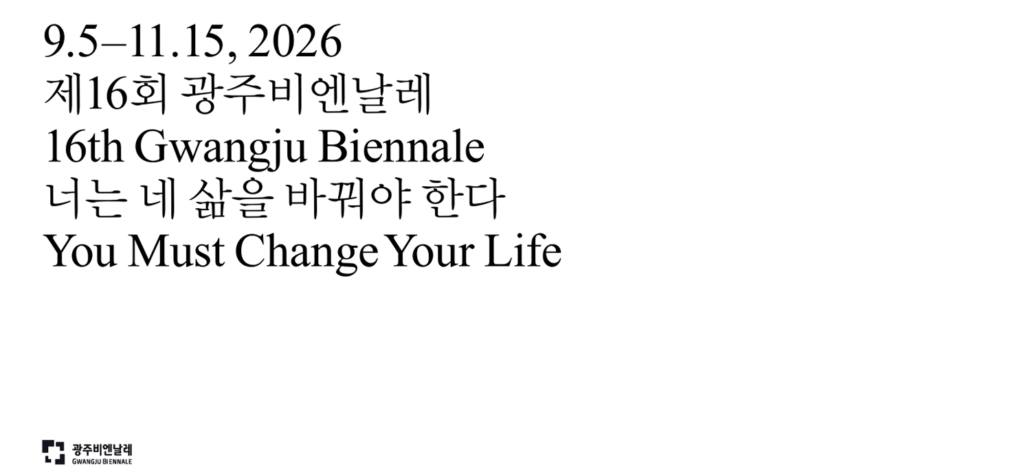
The main exhibition of the 2026 Gwangju Biennale, officially the 16th Gwangju Biennale, runs for 72 days from September 5 to November 15, 2026, primarily at the Gwangju Biennale Exhibition Hall. This year’s title is You Must Change Your Life. Artists and groups from 22 countries participate, presenting around 300 works spanning painting, sculpture, moving image, installation, performance, and other contemporary practices.
For international travelers visiting Gwangju, the 2026 Gwangju Biennale can also be combined with the Asia Culture Center, sites connected to the May 18 Democratic Uprising, Yangnim-dong, and other major cultural destinations. Visitors coming from Seoul can take the KTX and plan either a day trip or a more relaxed two-day itinerary.
• Exhibition: 16th Gwangju Biennale, You Must Change Your Life
• Dates: September 5–November 15, 2026
• Duration: 72 days
• Main venue: Gwangju Biennale Exhibition Hall
• Participants: 43 artists and teams from 22 countries
• Art forms include painting, video, installation, sculpture, and performance
What Does “You Must Change Your Life” Mean?
The title of the 2026 Gwangju Biennale comes from the final line of Rainer Maria Rilke’s 1908 poem Archaic Torso of Apollo.
In the poem, the speaker encounters a fragmented ancient sculpture and suddenly experiences a radical shift in how the world is perceived. As perspective and position change, the viewer realizes that life can no longer continue exactly as before. The famous final imperative is: “You must change your life.”
The 2026 Gwangju Biennale, however, does not prescribe a single direction in which life must change. Instead, it considers how transformation can emerge not only through sudden revolutions or moments of crisis, but also through repeated actions, habits, relationships, learning, care, and long-term practice.
• Title inspired by Rainer Maria Rilke
• Original poem: Archaic Torso of Apollo
• Published in 1908
• Central themes: transformation and practice
• Examines both personal and collective change
• Approaches artistic practice as a continuing process of transformation
Artistic Director Ho Tzu Nyen and 43 Participating Artists and Teams
The 2026 Gwangju Biennale is led by Singaporean visual artist and filmmaker Ho Tzu Nyen as Artistic Director. Gahee Park, Brian Kuan Wood, and Che Kyongfa participate as curators, while Yein Lee and Koyuri Sato serve as assistant curators.
The participating artists include figures from different generations and regions such as Angela Goh, Nam Hwayeon, Goldin+Senneby, Nina Canell, Lygia Clark, James Benning, Saodat Ismailova, and Suzuki Akio.
The exhibition also includes practices and presences that visitors may not normally expect to encounter in a conventional contemporary art exhibition, including the Volcanos of Jeju and the May Mothers House. Some artists appear repeatedly across different galleries, so the 2026 Gwangju Biennale is best experienced as one continuous journey rather than as a series of completely isolated rooms.
• Artistic Director: Ho Tzu Nyen
• Curator: Gahee Park
• Curator: Brian Kuan Wood
• Curator: Che Kyongfa
• Assistant Curator: Yein Lee
• Assistant Curator: Koyuri Sato
• 43 participating artists and teams
• Artists from multiple generations and regions
• Look for repeated artists and connections between works throughout the exhibition
Five Galleries Form One Continuous Journey
The main exhibition of the 2026 Gwangju Biennale is organized into five major galleries. Each has its own conceptual focus, but moving through them in sequence reveals an expanding structure that begins with molecules and gradually moves through the body, relationships, landscapes, the cosmos, and finally air.
The English gallery titles also use pairs of words beginning with the same letter—such as Molecules and Me and Bodies and Bonds—creating a linguistic rhythm that reinforces the conceptual progression of the exhibition.
Rather than rushing from artwork to artwork, visitors may find it helpful to consider how each gallery title connects to the next section of the 2026 Gwangju Biennale.
• Gallery 1: Molecules and Me
• Gallery 2: Bodies and Bonds
• Gallery 3: Landscapes and Learning
• Gallery 4: Cosmos and Change
• Gallery 5: Air and Articulations
• Overall structure expands from microscopic matter toward bodies, landscapes, the cosmos, and air
Gallery 1 | Molecules and Me
The first gallery of the 2026 Gwangju Biennale begins at a scale that is easy to overlook: molecules and material activity. Matter and the self are presented not as permanently separate or fixed entities, but as things that continuously dissolve, circulate, and reconnect.
The journey moves from molecules toward individual forms and then toward new combinations of different entities. The gallery encourages visitors to consider how the idea of a stable, independent “self” is complicated by continuous exchanges with objects, environments, and other forms of life.
• Starting point of the exhibition journey
• Explores molecules and material transformation
• Focuses on changing relationships rather than a fixed self
• Establishes conceptual ideas that continue into later galleries
Gallery 2 | Bodies and Bonds
The second gallery of the 2026 Gwangju Biennale focuses on bodies and relationships. The space can evoke divided arenas such as football fields or table-tennis courts, placing bodies in situations of confrontation, proximity, discipline, care, and repeated interaction.
Illness, injury, intimacy, training, and physical contact leave traces on the body. Repetition may limit everyday life, but it can also create new capacities, habits, and relationships. Some works invite visitors to experience movement rather than remaining completely passive observers.
• Focuses on the body and relationships
• Themes include care, training, illness, injury, and intimacy
• Some works involve movement and participation
• Considers how repetition can restrict and simultaneously transform human life
Gallery 3 | Landscapes and Learning
The third gallery of the 2026 Gwangju Biennale turns toward relationships between people, land, education, labor, and community. Humans cultivate and reshape the land, but they are also continually reshaped by the environments and communities in which they live.
Schools, agricultural fields, cities, and communities appear not simply as backgrounds but as spaces where knowledge, labor, habits, and ways of living are produced. Visitors interested in environmental questions, education, social structures, and power may find this gallery especially compelling.
• Relationships between landscape and people
• Agriculture and labor
• Schools and education
• Cities and communities
• Reconsiders relationships between environment, knowledge, and power
Gallery 4 | Cosmos and Change
The fourth gallery changes the atmosphere of the 2026 Gwangju Biennale dramatically, unfolding like a nighttime landscape. Sleep, dreams, moving images, geological time, and forms of existence that exceed the scale of a single human life broaden the idea of change.
The gallery includes entities associated with Jeju’s volcanic landscape, ceramic-like bodies, and forms resembling antennas capable of receiving signals. Compared with earlier galleries, this section expands the scale of transformation from the individual and social toward geological and cosmic time.
• Nighttime and dream-like atmosphere
• Moving images and geological forms
• Explores time beyond a single human lifespan
• References Jeju’s volcanic landscape and natural transformation
• Examines change from a cosmic perspective
Gallery 5 | Air and Articulations
The final gallery of the 2026 Gwangju Biennale moves away from clearly bounded physical forms and toward air, breathing, sound, language, and articulation.
Within an environment described through the image of a dismantled club, the visitor’s own body and breath become part of the exhibition experience. The journey that began with microscopic molecules concludes with invisible air and sound, completing the transition from material substance toward something less tangible.
• Air and breathing
• Sound and language
• The visitor’s body becomes part of the experience
• Final stage of the five-gallery journey
• Particularly suited to sensory and spatial viewing
Visiting in November? Check the Closing Program
Before the 2026 Gwangju Biennale closes on November 15, a dedicated Closing Program will take place from November 6 to November 8, 2026.
The program is scheduled across the Gwangju Biennale Exhibition Hall, Geosigi Hall, and surrounding outdoor spaces. Performances, workshops, screenings, and conversations will explore how artistic practices, research, relationships, and collective processes can continue beyond the formal end of an exhibition.
Some programs have limited capacity and require advance registration. According to the current information, registration is available until October 29. Certain sessions may also require a main exhibition ticket, so travelers visiting in early November should check the Closing Program separately rather than planning only a regular exhibition visit.
• Closing Program: November 6–8, 2026
• Venues: Gwangju Biennale Exhibition Hall, Geosigi Hall, and outdoor spaces
• Performances
• Workshops
• Screenings
• Conversations with artists and curators
• Some programs require advance registration
• Current registration deadline: October 29
2026 Gwangju Biennale Ticket Prices
The current regular admission prices for the 2026 Gwangju Biennale are KRW 20,000 for adults, KRW 10,000 for teenagers, and KRW 7,000 for children.
Early-bird discounts applied only through September 4, before the official opening, so visitors attending now should use the regular prices as the main reference.
Separate discounts may apply to repeat visitors, groups, local residents, and eligible concession categories. Because documentation requirements vary, travelers planning to use a discounted ticket should confirm the current eligibility rules before visiting.
• Adults, ages 19–64: KRW 20,000
• Teenagers, ages 13–18: KRW 10,000
• Children, ages 4–12: KRW 7,000
• Some categories, including children aged 3 and under, may qualify for free admission
• Separate repeat-visit, group, and concession discounts may apply
• Online ticket purchase available
2026 Gwangju Biennale Opening Hours and Closed Days
The main exhibition of the 2026 Gwangju Biennale is open from 10:00 AM to 6:00 PM, Tuesday through Sunday. Final admission is at 5:30 PM.
Mondays are generally closed, although exceptional opening dates have applied during the opening period, including September 7 and October 5, as well as designated holiday schedules. The biennale continues through November 15.
Because of the scale of the galleries and the number of works, arriving shortly before closing is not recommended. Visitors should allow several hours for a comfortable experience.
• Exhibition dates: September 5–November 15, 2026
• Tuesday–Sunday: 10:00 AM–6:00 PM
• Last admission: 5:30 PM
• Generally closed on Mondays
• Allow enough time rather than arriving close to closing
Allow at Least 2–3 Hours for Your First Visit
With five large galleries containing moving-image works, installations, sound pieces, and participatory works, the 2026 Gwangju Biennale is better experienced slowly rather than as a quick walk-through.
Visitors who want to watch video works properly and read the exhibition texts should consider allowing at least two to three hours. Contemporary art enthusiasts who want to explore connections between works and spend more time with long-form videos may prefer to allocate half a day.
The structure of the 2026 Gwangju Biennale also rewards visitors who remain with individual works long enough to discover repeated symbols, connections, and relationships between different parts of the exhibition.
• Allow more time rather than rushing
• General visit: consider at least 2–3 hours
• Half a day may be suitable for detailed viewing
• Comfortable shoes are recommended
• For long video works, prioritize the pieces that interest you most
Useful Information for International Visitors
The official Gwangju Biennale website provides an English-language version, allowing international visitors to check the exhibition theme, gallery structure, programs, participating artists, and practical visitor information before arriving.
The 2026 Gwangju Biennale contains many moving-image, sound, spatial, and concept-driven works. Understanding the basic themes of the five galleries in advance can therefore make the exhibition easier to follow.
Some special programs also provide interpretation beyond Korean. For example, selected Closing Program events are announced with consecutive interpretation in Korean, Japanese, and English.
• Official English-language website available
• Reviewing the five gallery themes in advance can improve the visit
• Some programs provide English interpretation
• Allow sufficient time for moving-image works
• Recommended for international contemporary art travelers
Visitor Rules Inside the Exhibition
Several rules are in place to protect the artworks and provide a comfortable viewing environment during the 2026 Gwangju Biennale.
Visitors must not touch the exhibited works. Food, pets, and long umbrellas cannot be brought into the exhibition halls. Heavy belongings should be left at the storage area, while folding umbrellas should be placed inside a bag.
Selfie sticks, flash photography, and tripods are prohibited inside the galleries. Visitors accompanied by children should pay close attention to them, and everyone is asked to view the exhibition quietly without disturbing other visitors.
Nursing rooms are available, and visitors who need wheelchairs or strollers can ask the operating staff for assistance.
• Do not touch the artworks
• Food is not permitted inside
• Pets are not permitted inside
• Long umbrellas are not permitted
• Selfie sticks, flash photography, and tripods are prohibited
• Use the storage area for heavy belongings
• Wheelchairs and strollers are available upon request
What Naver Map and Google Map Visitors Commonly Mention
Public visitor feedback on Naver Map, Google Map, and other review platforms often describes the Gwangju Biennale as a place for slowly experiencing a large-scale exhibition rather than briefly viewing only a few artworks.
Korean visitors frequently mention that experimental installations, participatory works, and the opportunity to consider the meaning of individual works make the exhibition interesting. International visitors often highlight the unusual contemporary art, spacious galleries, and the possibility of combining the exhibition with nearby parks and cultural facilities.
Some international reviews also emphasize the importance of English explanations. Visitors who want more detailed context in English may therefore find it useful to use the official English information together with their visit to the 2026 Gwangju Biennale.
• Positive feedback about the large exhibition spaces
• Many experimental and distinctive works
• Visitors often recommend taking time rather than rushing
• Participatory works are frequently mentioned as interesting
• Convenient to combine with surrounding parks and cultural facilities
• International visitors may benefit from checking English exhibition information in advance
Gwangju Biennale Exhibition Hall Location
The main venue of the 2026 Gwangju Biennale is the Gwangju Biennale Exhibition Hall at 111 Biennale-ro, Buk-gu, Gwangju.
The administrative address of the Gwangju Biennale Foundation can appear separately in search results, so visitors using a map application should make sure they are navigating specifically to the exhibition hall.
The venue is situated in the Jungoe Park cultural district, making it possible to combine the biennale with the Gwangju Museum of Art and nearby green spaces.
• Address: 111 Biennale-ro, Buk-gu, Gwangju
• Main venue of the 2026 Gwangju Biennale
• Located within the Jungoe Park cultural district
• Can be combined with the Gwangju Museum of Art and nearby cultural attractions
• Search specifically for “Gwangju Biennale Exhibition Hall” when using a map app
Gwangju Biennale Exhibition Hall Naver Map
Gwangju Biennale Exhibition Hall Google Map
How to Get to the 2026 Gwangju Biennale from Yongsan Station in Seoul
One of the most convenient routes from Seoul is to take the KTX from Yongsan Station to Gwangju-Songjeong Station and then continue to the 2026 Gwangju Biennale by local public transportation.
In the provided route example, the journey from Yongsan Station to Gwangju-Songjeong Station by KTX, followed by a local bus to the exhibition area, takes approximately 2 hours 54 minutes in total and costs around KRW 43,400.
The example shows approximately 1 hour 55 minutes on the KTX, followed by around 50 minutes of local transportation in Gwangju. Train schedules and prices vary by departure time, so travelers should recheck their KTX seat and fare before the actual travel date.
• Starting point: Yongsan Station
• Take the KTX
• Get off at Gwangju-Songjeong Station
• Continue by local bus toward the exhibition hall
• Example total journey: approximately 2 hours 54 minutes
• Example total fare: approximately KRW 43,400
• Advance KTX reservations are recommended for weekends
Can You Visit the 2026 Gwangju Biennale as a Day Trip from Seoul?
A same-day trip from Seoul is possible if the 2026 Gwangju Biennale is the main purpose of your visit and you use the KTX.
However, travelers should account for the round-trip journey between Seoul and Gwangju, local transportation from Gwangju-Songjeong Station, and at least two to three hours for the exhibition itself.
If you also want to visit the Asia Culture Center, Chungjang-ro, Yangnim-dong, or sites related to the May 18 Democratic Uprising, a one-night, two-day itinerary will provide a much more comfortable experience.
• Day trip is possible if the biennale is the primary destination
• Consider round-trip Seoul–Gwangju travel time
• Allow at least 2–3 hours for the exhibition
• A 1-night, 2-day itinerary is better for additional Gwangju sightseeing
• Book weekend KTX tickets in advance when possible
How to Get to the Gwangju Biennale from Busan Centum City
Travelers coming from Busan can use an express bus from the Honam line area of Centum City Terminal to Gwangju Bus Terminal, followed by local transportation to the 2026 Gwangju Biennale.
In the provided route example, traveling from Centum City Terminal to Gwangju Bus Terminal and then transferring to a local bus takes approximately 4 hours 14 minutes, with a total fare of around KRW 23,950.
Travel time and fares may vary depending on the bus departure and seat class, so visitors traveling from Busan should check the timetable for their actual date.
• Starting point: Centum City Terminal, Honam Line
• Take an express bus toward Gwangju Bus Terminal
• Transfer to a local bus after arriving in Gwangju
• Example total journey: approximately 4 hours 14 minutes
• Example fare: approximately KRW 23,950
• Bus fares vary depending on seat class and departure time
Parking at the 2026 Gwangju Biennale
Visitors arriving by car are directed to use the official P3 Biennale Large Parking Lot.
Parking areas around the 2026 Gwangju Biennale may become busy during weekends, public holidays, and major event periods. Visitors who prefer a more relaxed arrival may want to come earlier in the day or consider public transportation.
• Official P3 Biennale parking lot available
• Weekend and holiday congestion is possible
• Morning arrival may provide a more relaxed visit
• Check the walking route from the parking area to the exhibition hall
How to Enjoy the 2026 Gwangju Biennale More Fully
The 2026 Gwangju Biennale is more rewarding when visitors look for relationships between different artworks rather than treating the exhibition as a checklist of famous pieces.
As you move from the molecules of the first gallery toward the air of the final gallery, consider how the scale of each space expands. When an artist appears again later in the exhibition, think about how the new work connects to what you saw earlier.
If contemporary art feels difficult, there is no need to understand every work. Selecting several pieces that produce the strongest personal response and spending more time with them can be a better way to experience the biennale.
• Visit the five galleries in sequence
• Read each gallery title before entering
• Look for artists who appear more than once
• Prioritize moving-image works that interest you most
• Focus on your own response rather than searching for one correct interpretation
• Allow enough time for a slower visit
Planning an Art Trip to Korea in Fall 2026?
The 2026 Gwangju Biennale is not simply a large contemporary art exhibition filled with famous works. It is structured around a much broader question: how does life change?
That question expands from molecules to bodies, relationships, landscapes, the cosmos, and air, allowing visitors to experience transformation through multiple scales and artistic approaches.
Reaching Gwangju requires additional travel from Seoul or Busan, but the biennale is particularly worthwhile for travelers interested in contemporary art, Korean regional history, democracy, social transformation, and experimental artistic practice.
The exhibition is currently underway and continues until November 15, with Closing Program events scheduled in November. Travelers planning an autumn 2026 trip to Gwangju should therefore check their dates before the exhibition closes.
• One of Korea’s leading international contemporary art events
• Continues through November 15, 2026
• Features 43 participating artists and teams
• Five interconnected exhibition galleries
• Opportunity to connect contemporary art with Gwangju’s history
• Recommended for a fall cultural trip in Korea
Discover Korean Hospitals, Exhibitions, and Travel Information with Kosmedi
Kosmedi helps international travelers and foreign patients access practical medical and travel information in Korea. Kosmedi introduces hospitals checked by local Korean staff and medical institutions with confirmed interpretation services. Visitors can explore information about dermatology, plastic surgery, health checkups, and other medical programs, including treatments, prices, events, patient reviews, and detailed hospital introductions.
For Kosmedi partner hospitals and clinics, international visitors can also check whether Kosmedi-exclusive discount coupons and special events are available. Before arriving in Korea or while staying in the country, travelers can use real-time messaging consultation to ask questions about hospital reservations and medical services.
Kosmedi is not limited to hospital information. The service also introduces major Korean exhibitions and cultural events such as the 2026 Gwangju Biennale, along with restaurants, cafés, festivals, pop-up stores, tourist attractions, discounts, special events, popular destinations, and local places frequently visited by Korean residents.
From foreign patients planning travel around medical appointments to general international visitors who want to explore regions beyond Seoul, Kosmedi helps users find both medical and travel information in one place.
• Hospital information checked by local Korean staff
• Medical institutions with confirmed interpretation services
• Treatment, health checkup, price, event, and patient review information
• Kosmedi-exclusive discount coupons and special events
• Real-time messaging consultation
• Korean exhibitions, biennales, and festival information
• Restaurant and café guides
• Regional tourist attraction information
• Discount, event, and pop-up store information
• Local places frequently visited by Korean residents

