



Why Visit Mokpo Natural History Museum During a Trip to Mokpo?
Mokpo is a major port city on the southwestern coast of Jeollanam-do, South Korea. It is a destination where nature, history, and culture come together through attractions such as Yudalsan Mountain, Gatbawi, Mokpo Port, and the Modern History District.
Although Mokpo is widely known for coastal scenery and island tourism, Mokpo Natural History Museum is also worth adding to your itinerary if you are looking for an indoor attraction that can be enjoyed comfortably on rainy, cold, or hot days.
Mokpo Natural History Museum is not simply a place to see dinosaur models. Its exhibition halls cover the formation of Earth, geology, fossils, dinosaurs, terrestrial animals, marine life, and the ecology of the Mokpo region, allowing visitors to follow the broader story of natural history.
For families traveling with children, displays such as dinosaur skeletons, animal specimens, fossils, and minerals are visually accessible and can combine education with sightseeing.
The museum is also connected with the Gatbawi cultural district, where several cultural facilities are located, making it possible to plan a half-day itinerary rather than visiting only one museum.
• One of Mokpo’s major indoor attractions
• Dinosaurs, fossils, minerals, and biological exhibits
• Suitable for children and family travel
• Convenient destination during rain or extreme weather
• Easy to combine with attractions around the Gatbawi cultural district
What Is Mokpo Natural History Museum?
Mokpo Natural History Museum was established by Mokpo City to systematically introduce the natural environment and cultural heritage of the region.
The institution developed from earlier facilities such as a local culture hall and shell exhibition room. Full-scale construction began in 2001, and the present Mokpo Natural History Museum officially opened in September 2004.
Today, the museum complex is broadly composed of the Natural History Hall, Literature and History Hall, and Living Ceramics Museum. This structure allows visitors to explore natural history, regional culture, art, and ceramics within the same cultural district.
The Natural History Hall presents approximately 4.6 billion years of Earth’s natural history. In addition to dinosaurs and fossils, visitors can see meteorites, minerals, insects, birds, mammals, fish specimens, and plants.
• Opened in September 2004
• Major natural history facility in Mokpo
• Natural History Hall, Literature and History Hall, and Living Ceramics Museum
• Exhibitions covering approximately 4.6 billion years of Earth’s history
• Topics ranging from dinosaurs to regional ecology
Start at the Central Hall If You Love Dinosaurs
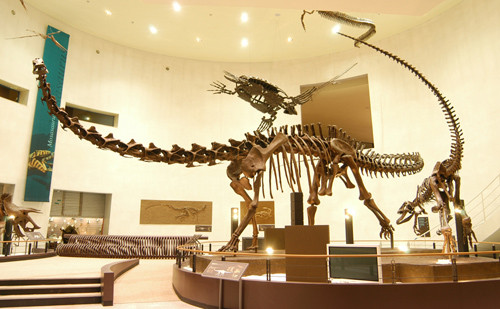
Dinosaurs are one of the main reasons many families visit Mokpo Natural History Museum.
In the Central Hall, visitors can follow the history of life from the formation of Earth through the Paleozoic, Mesozoic, and Cenozoic eras using dinosaurs and other organisms as key reference points.
The displays introduce periods such as the Triassic, Jurassic, and Cretaceous, helping visitors understand not only dinosaur skeletons but also how different organisms lived during different geological periods.
Dinosaur skeletons and prehistoric life exhibits are especially popular with children, while adults interested in natural history can also follow Earth’s history in chronological order.
International visitor reviews also mention that the animal and dinosaur exhibits are especially appealing to children and that the scale and detail of the displays are impressive.
• Dinosaur skeletons and prehistoric life exhibits
• Triassic, Jurassic, and Cretaceous periods
• Easy introduction to the history of life on Earth
• Popular with children and families
• Accessible introduction to natural history
See Rare Dinosaur Fossils at Mokpo Natural History Museum
One of the exhibitions worth paying particular attention to at Mokpo Natural History Museum is its dinosaur fossil collection.
Official Mokpo tourism information introduces rare dinosaur fossils, including Prenoceratops, as well as a carnivorous dinosaur egg nest fossil discovered on Aphaedo Island in Sinan.
The carnivorous dinosaur egg nest fossil discovered in the region is known as a particularly notable dinosaur fossil specimen found in Korea.
In 2026, a new Oviraptor dinosaur sculpture inspired by the dinosaur egg nest fossil was also added, connecting the indoor dinosaur and fossil exhibitions with an outdoor experiential space.
Families with children who are particularly interested in dinosaurs may therefore want to explore both the indoor exhibition halls and the outdoor areas.
• Rare dinosaur fossils
• Carnivorous dinosaur egg nest fossil from Aphaedo, Sinan
• Exhibitions centered on real natural history materials
• Oviraptor sculpture added in 2026
• Recommended for families interested in dinosaurs and fossils
Learn How Earth Was Formed in the Geology Hall
The Geology Hall is another part of Mokpo Natural History Museum that is worth exploring even if dinosaurs are your main reason for visiting.
The hall introduces rocks, minerals, and meteorites to explain what Earth is made of and how the planet has changed over time.
Topics such as meteorites, materials that form Earth’s crust, minerals, and rocks may sound difficult for younger visitors, but observing actual specimens can make these concepts much easier to understand than simply reading about them in a textbook.
Comparing minerals and fossils with different shapes, textures, and colors is also one of the more engaging ways to explore the museum.
By visiting the Geology Hall together with the dinosaur galleries, visitors can connect the evolution of life with the changing environments in which those organisms lived.
• Meteorite exhibits
• Minerals and rocks
• Introduction to Earth’s structure and geological change
• Fossils and geology can be understood together
• Useful for children’s science learning
Explore Animals and Evolution in the Terrestrial Life Hall
The Terrestrial Life Hall at Mokpo Natural History Museum introduces a wide range of land animals from the past and present.
Mammals, birds, insects, and plants are displayed through specimens, taxidermy, and skeletal materials, allowing visitors to compare how organisms adapted to different environments.
The exhibitions also examine the appearance and evolution of life, changes in fish, amphibians and reptiles, and mammals of the Cenozoic era.
Large displays containing many different animal specimens are particularly useful for children because different species can be compared visually in one space.
International reviews also mention that the museum offers much more than dinosaurs, with land animals, plants, insects, and other natural history subjects providing enough variety for families to spend a substantial amount of time inside.
• Mammals, birds, insects, and plants
• Animal specimens and skeletal materials
• Introduction to biological evolution
• Multiple organisms displayed for easy comparison
• Suitable for family educational visits
Do Not Miss the Aquatic Life Hall and Regional Ecology Hall
Because Mokpo is a port city located close to the sea, marine life and regional ecology are also important parts of Mokpo Natural History Museum.
The Aquatic Life Hall presents marine organisms and various specimens to help visitors understand how marine ecosystems are structured.
The Regional Ecology Hall focuses on natural environments and organisms found around Mokpo and Yudalsan Mountain, giving the museum a distinctive local character compared with natural history museums that concentrate mainly on global topics.
Visitors can learn about plants growing around Yudalsan, natural environments along Korea’s southwestern coast, and aquatic organisms, connecting broader natural history with the ecology of Mokpo itself.
Some ecological experience spaces also present coastal, tidal flat, and aquatic environments in a more immersive format.
• Marine life specimens
• Ecology of Korea’s southwestern coast
• Plants and animals of Mokpo and Yudalsan
• Comparison of aquatic and regional ecosystems
• Useful for understanding Mokpo’s natural environment
Experience AR, Media Facades, and 4D Attractions
Mokpo Natural History Museum is not limited to traditional glass display cases and static specimens. It also provides several immersive and interactive experiences.
In the museum lobby, visitors can use AR content that creates the experience of taking photos with different organisms, while the Central Hall features a media facade that presents natural history through large-scale visual content.
Interactive AR services connected with major museum exhibits also allow children to participate more actively while learning about the displays.
The 4D theater combines 3D video with effects such as water, wind, and vibration, creating a different experience from watching a conventional film.
These interactive features can also help maintain children’s interest even if they are not especially enthusiastic about fossils or dinosaurs.
• AR photo and interactive content
• Central Hall media facade
• Interactive services connected with museum exhibits
• 4D theater
• Immersive content designed to increase children’s participation
Explore the VR Online Exhibition Before Your Visit
Mokpo Natural History Museum also provides a VR online exhibition in addition to its physical galleries.
The VR exhibition allows users to explore major spaces such as the first and second floors of the Natural History Hall and the Literature and History Hall online, giving visitors an advance look at the museum atmosphere and exhibition layout.
It can be useful for showing children what they will see before a family trip or for checking the museum layout and deciding which exhibition halls to prioritize.
International travelers planning a trip to Korea can also use the VR content to preview the scale of the museum and identify exhibits they are particularly interested in before arriving in Mokpo.
• Online Natural History Hall experience
• Preview major exhibition spaces
• Useful for planning a visit in advance
• Suitable for family pre-trip learning
• Accessible for international travelers before visiting Korea
Why You Should See More Than Just the Natural History Hall
One of the advantages of visiting Mokpo Natural History Museum is that the experience does not end with the Natural History Hall.
Visitors can also explore the Literature and History Hall and the Living Ceramics Museum as part of the wider museum complex.
The Literature and History Hall includes displays related to viewing stones, artworks, Mokpo’s cultural and artistic history, and currency.
The Living Ceramics Museum presents Korean everyday ceramics and contemporary ceramic works, offering a completely different atmosphere after exploring dinosaurs, fossils, and natural history.
This variety makes the destination suitable for families whose members have different interests, from children who enjoy science to adults interested in art and regional culture.
• Natural History Hall
• Literature and History Hall
• Living Ceramics Museum
• Natural science and cultural art in one area
• Convenient for families with different interests
See a Special Ceramics Exhibition in 2026
During the second half of 2026, visitors can also see a special exhibition at the Living Ceramics Museum.
The current exhibition is titled “2026 Second Half Mokpo Living Ceramics Museum Special Exhibition: City on a Chessboard — Form (形)” and runs from October 23, 2026, through March 17, 2027.
The exhibition presents 37 works by artist Yoon Ji-yong, who reinterprets everyday objects such as houses and human figures through the language of ceramic sculpture.
It is organized around three groups of works: House, Social Skin, and Chessman. Familiar forms such as houses, bricks, chessboards, and chess pieces are used to explore how ordinary objects can take on new meanings within contemporary society.
If you visit Mokpo in November 2026, this is a period when you can combine the natural history exhibitions with a contemporary ceramics exhibition during the same trip.
• Special exhibition during the second half of 2026
• Exhibition period: October 23, 2026–March 17, 2027
• 37 contemporary ceramic works
• House, Social Skin, and Chessman series
• Opportunity to experience natural history and contemporary ceramics together
What Do Korean Visitors Say in Naver Map Reviews?
Naver Map-related information shows that Mokpo Natural History Museum has accumulated many visitor reviews and Korean blog posts.
Korean visitors frequently describe it as a good attraction for families with children, particularly because dinosaur, fossil, and animal exhibits can easily attract children’s attention.
Some reviews say that the variety of exhibitions is greater than expected and recommend allowing enough time rather than planning only a short visit.
Interactive elements are also mentioned as a reason children remain interested for longer than they might in a museum composed only of static exhibits.
Family visitors also mention the advantage of being able to visit multiple cultural facilities in the same area and combine the museum with attractions around the Gatbawi cultural district.
• Frequently recommended for families with children
• Strong interest in dinosaur and fossil exhibits
• Wide range of natural history materials
• Interactive content mentioned positively
• Often recommended as a family attraction in Mokpo
What Do International Travelers Say in Google Reviews?
Public Google-based reviews give Mokpo Natural History Museum a rating in the 4-point range, with a substantial number of visitor reviews accumulated over time.
International visitors often say that the dinosaur and animal exhibits are especially enjoyable for children and appreciate being able to visit natural history, art, currency, and ceramics-related facilities in the same cultural area.
Some reviews also mention the detail and condition of the displays, while family visitors say their children wanted to return after the visit.
However, some international travelers note that the amount of English-language explanation can vary depending on the exhibition area. Visitors who want more detailed background information may therefore find it useful to check the museum’s foreign-language website before or during their visit.
The official website provides information in English, Chinese, and Japanese, allowing overseas travelers to review basic visitor information before arriving.
• Rated in the 4-point range on Google-based review platforms
• Positive reactions to dinosaur and animal exhibits
• Generally well received by family visitors
• Advantage of visiting several museum facilities in one area
• English explanations may vary by exhibition
• Foreign-language information available through the official website
How Much Time Should You Spend at Mokpo Natural History Museum?
Mokpo Natural History Museum is closer to a cultural complex than a small museum designed for a quick visit.
If you focus only on the main exhibitions in the Natural History Hall, the visit can be relatively short. However, exploring dinosaurs, fossils, geology, terrestrial life, aquatic life, the Regional Ecology Hall, and interactive experiences can take considerably longer.
Visitor information indicates that seeing the Natural History Hall together with the Literature and History Hall generally takes approximately one to one and a half hours.
If you also include the Living Ceramics Museum, the special exhibition, 4D content, and AR experiences, allowing two hours or more can be reasonable.
Families traveling with children should plan additional time for interactive experiences and breaks.
• Main Natural History Hall: around one hour depending on pace
• Natural History Hall + Literature and History Hall: approximately 1–1.5 hours or more
• Including interactive experiences and ceramics exhibitions: consider 2 hours or more
• Families with children should allow additional time
Mokpo Natural History Museum Opening Hours and Closing Days
As of November 2026, the standard opening hours for Mokpo Natural History Museum are from 9:00 AM to 6:00 PM.
Final admission is one hour before closing, so visitors arriving in the late afternoon should pay attention to the entry deadline.
From June through August, the museum extends operating hours by one hour on Saturdays, Sundays, and public holidays.
The regular closing day is Monday. If Monday falls on a public holiday or part of a holiday period, the museum closes the following day instead.
• Standard hours: 9:00 AM–6:00 PM
• Final admission: one hour before closing
• June–August weekends and public holidays: one-hour extended operation
• Regular closing day: Monday
• If Monday is a public holiday, the museum closes the following day
• Check current operating information before visiting
Mokpo Natural History Museum Location and Parking
Mokpo Natural History Museum is located at 135 Namnong-ro, Mokpo-si, in the Yonghae-dong Gatbawi cultural district.
Several cultural facilities are concentrated in this area, making it convenient for families to plan a longer sightseeing itinerary around the museum.
Visitors can use parking facilities near the museum as well as a Mokpo public parking area located approximately 100 meters away.
Families traveling by car can also combine their museum visit with Gatbawi or a walk along the nearby coastal area.
• Location: 135 Namnong-ro, Mokpo-si
• Located in the Yonghae-dong Gatbawi cultural district
• Parking available
• Nearby public parking available
• Convenient for visiting surrounding cultural facilities
Mokpo Natural History Museum Naver Map
Mokpo Natural History Museum Google Map
How to Get to Mokpo Natural History Museum from Mokpo Station
Public buses are a practical way to travel from Mokpo Station to Mokpo Natural History Museum.
Based on the provided transportation route, travelers can take Bus 22-1 or Bus 22 from a stop near Mokpo Station and reach the museum area in approximately 20 minutes.
One route involves getting off near the National Maritime Heritage-related facility and walking a short distance to the museum.
Actual travel time can vary depending on bus arrival times and traffic, so checking real-time transportation information immediately before departure is recommended.
• Starting point: Mokpo Station
• Approximately 20 minutes by public transportation
• Bus 22-1 or Bus 22 can be used
• Short walk after getting off the bus
• Check real-time bus information before departure
How to Get to Mokpo Natural History Museum from Mokpo Bus Terminal
Travelers starting from Mokpo Intercity Bus Terminal can also reach Mokpo Natural History Museum by local bus.
The provided route information shows a journey of approximately 29 minutes, with options involving Bus 77 or Bus 66 followed by a transfer toward the museum area.
Some routes allow visitors to get off at a stop serving the Mokpo Natural History Museum area, making the museum relatively accessible even for travelers without a car.
However, total travel time can change depending on bus intervals and transfer waiting times.
• Starting point: Mokpo Intercity Bus Terminal
• Approximately 29 minutes by public transportation
• Local bus and transfer options available
• Museum-area bus stop available
• Travel time varies depending on bus intervals
Why Mokpo Natural History Museum Is Especially Good for Families with Children
One reason Mokpo Natural History Museum works well for family travel is the variety of subjects that can easily attract children’s attention.
The themes constantly change from dinosaurs to animals, fish, insects, minerals, and meteorites, reducing the feeling of repeatedly seeing the same type of exhibit.
Interactive elements such as AR, 4D content, and media facades also provide new ways to engage children if their attention begins to fade during traditional exhibitions.
Family visitor reviews also suggest that both younger children and older children can find something enjoyable at the museum.
• Recommended for children who enjoy dinosaurs
• Animals, insects, and marine life
• AR and 4D interactive experiences
• Indoor family attraction
• Combines education and sightseeing
Why International Travelers Can Enjoy Mokpo Natural History Museum
Language can sometimes be a barrier for international visitors at regional museums in Korea, but Mokpo Natural History Museum provides official website information in English, Chinese, and Japanese.
Many of the main exhibits, including dinosaur skeletons, animal specimens, fossils, and minerals, are also visually understandable even without reading extensive Korean explanations.
This can be particularly useful for international families traveling with children, as major exhibits can still be enjoyed without complete Korean-language proficiency.
However, some international visitor reviews mention that English descriptions are not equally detailed throughout every exhibition area. Travelers who want deeper background information may therefore want to review the foreign-language website before visiting.
• Official website support in English, Chinese, and Japanese
• Visually accessible dinosaur and animal exhibits
• Useful indoor destination for international families
• Checking foreign-language information in advance is recommended
Looking for a Family Attraction in Mokpo, Korea?
Mokpo Natural History Museum is more than a museum containing a few dinosaur displays. It is a cultural complex where visitors can experience natural history, regional ecology, art, culture, and ceramics within the same area.
Children interested in dinosaurs and fossils can focus on the Natural History Hall, while adults may also enjoy the Literature and History Hall and Living Ceramics Museum.
AR, media facades, and 4D content provide interactive experiences that can make the museum more accessible even to visitors who normally find educational museums less engaging.
The museum can be reached from Mokpo Station and the bus terminal by public transportation, and parking is also available, making it suitable for both car-based and public transportation itineraries.
If you are searching for things to do in Mokpo on a rainy day, family attractions, dinosaur museums, or indoor destinations for children, Mokpo Natural History Museum is worth considering.
• Major family attraction in Mokpo
• Dinosaurs, fossils, animals, and regional ecology
• Natural history and cultural art in one area
• Suitable as an indoor travel destination
• Accessible by both public transportation and car
Find Korean Medical and Local Travel Information with Kosmedi
Kosmedi (becoming KormPath) is a service designed to help international travelers and foreign patients prepare medical care and travel plans in Korea more conveniently.
Users can check hospital information reviewed by local Korean staff, whether interpretation support is available, medical procedures, health screening information, hospital events, and patient reviews. Kosmedi also provides access to exclusive discount coupons and special events available through the service.
If travelers have questions about hospitals or appointments, they can also use real-time messaging support.
In addition to medical information, Kosmedi introduces Korean tourist attractions such as Mokpo Natural History Museum, restaurants, festivals, discount events, popular destinations, and places frequently visited by local residents.
This allows international travelers to prepare Korean medical care and travel experiences within the same service.
• Hospital information checked by local Korean staff
• Information about available interpretation support
• Medical procedures, health screenings, events, and reviews
• Kosmedi-exclusive discount coupons and events
• Real-time messaging support
• Korean attractions, restaurants, festivals, and local travel information

