


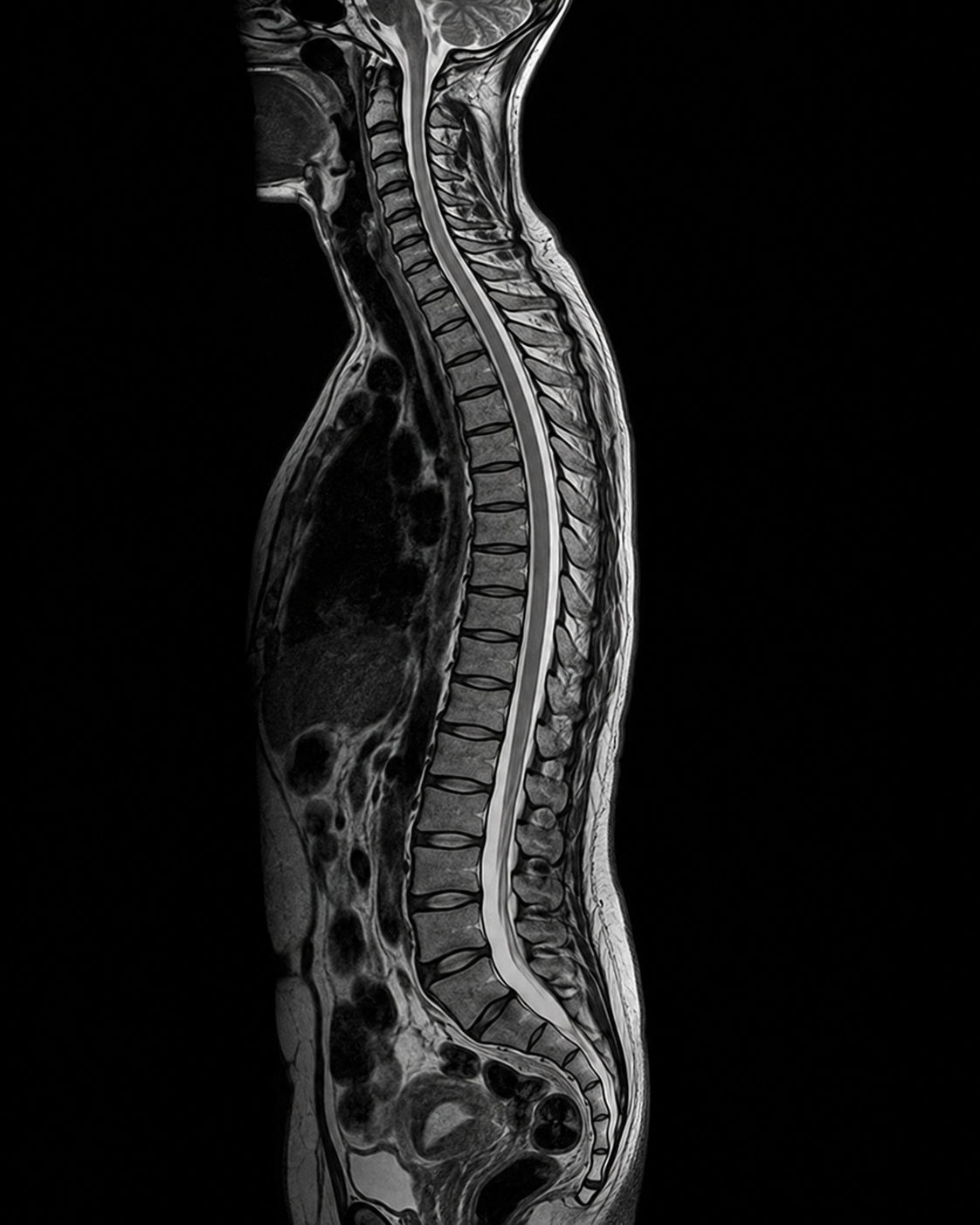
If you are considering a spine MRI in Korea, the first question is not simply whether you need an MRI. You need to identify which section of the spine should be examined. A cervical spine MRI focuses on the neck, generally covering the C1-C7 vertebrae, while a lumbar spine MRI focuses on the lower back, generally covering L1-L5 and the lumbosacral junction. Neck pain, arm or hand numbness, and symptoms suggesting cervical nerve or spinal cord involvement generally point toward the cervical region. Lower-back pain, sciatica, buttock or leg symptoms, and foot numbness generally point toward the lumbar region. MRI is especially useful for examining discs, nerves, the spinal cord, the spinal canal, ligaments, and other soft tissues.
Hanshin Medipia MRI examinations in Seoul include both cervical spine MRI and lumbar spine MRI, along with brain MRI, cerebrovascular MRA, special joint MRI, pancreas MRI, and a broader MRI screening option combining several regions. Hanshin Medipia has more than 40 years of health-screening experience and operates a dedicated Radiology Center. English-language information and international-patient support are also available.
Cervical Spine MRI vs Lumbar Spine MRI at a Glance
The main difference is anatomical location. A cervical spine MRI examines the neck and the upper portion of the spinal cord. A lumbar spine MRI examines the lower back and the nerve structures that continue toward the pelvis and legs.
| MRI Region | Main Levels | Common Symptom Area | Common Reasons for Evaluation |
|---|---|---|---|
| Cervical spine MRI | C1-C7 | Neck, shoulders, arms, hands | Disc problems, nerve compression, spinal canal narrowing, spinal cord compression |
| Lumbar spine MRI | L1-L5 and L5-S1 region | Lower back, buttocks, legs, feet | Disc problems, sciatica, lumbar stenosis, nerve-root compression |
MRI can evaluate spinal alignment, discs, nerves, the spinal cord, and soft tissues in much greater detail than a basic X-ray. It may be used to evaluate disc disease, nerve compression, spinal stenosis, trauma, inflammation, infection, or other abnormalities depending on the patient’s symptoms.
What Levels Does a Cervical Spine MRI Check?
The cervical spine is the neck section of the spine and contains seven vertebrae, C1 through C7. When MRI reports discuss cervical disc levels, commonly evaluated disc spaces extend from C2-C3 through C7-T1.
The lower cervical levels are particularly important because degenerative changes and disc problems frequently occur around C5-C6 and C6-C7. These lower cervical levels often receive considerable mechanical stress and may be associated with neck pain, shoulder symptoms, or neurological symptoms extending into the arm and hand.
• Persistent neck pain
• Pain spreading from the neck toward the shoulder or arm
• Tingling or numbness in an arm or hand
• Hand or arm weakness
• Suspected cervical disc herniation
• Suspected cervical spinal stenosis
• Possible spinal cord compression
• Neurological symptoms involving the upper limbs
Cervical MRI commonly includes sagittal images through the neck and axial images targeted at individual levels so that the intervertebral discs, spinal canal, spinal cord, and neural foramina can be evaluated.
What Levels Does a Lumbar Spine MRI Check?
The lumbar spine is the lower-back section and contains five lumbar vertebrae, L1 through L5. Clinically important disc levels commonly extend from L1-L2 through L5-S1, where the lumbar spine meets the sacrum.
L4-L5 and L5-S1 are particularly important because they are common locations for degenerative disc changes and lumbar nerve-root problems. Problems at these levels may contribute to lower-back pain, sciatica, leg pain, numbness, or weakness depending on which nerve structures are affected.
• Persistent lower-back pain
• Pain spreading into the buttock or leg
• Sciatica-type symptoms
• Numbness or tingling in a leg or foot
• Leg weakness
• Suspected lumbar disc herniation
• Suspected lumbar spinal stenosis
• Suspected nerve-root compression
If your symptoms are primarily below the waist, a lumbar MRI may provide more relevant information than a cervical MRI. However, the appropriate scan should ultimately be selected according to symptoms and clinical evaluation rather than self-diagnosis.
Which MRI Level Do You Need?
A practical way to understand cervical spine MRI vs lumbar spine MRI is to follow where the symptoms occur.
Neck symptoms extending into the shoulder, arm, hand, or fingers generally suggest evaluation of the cervical spine. Lower-back symptoms extending through the buttock, thigh, calf, or foot generally suggest evaluation of the lumbar spine.
However, symptoms do not always follow a perfect pattern. A spinal cord problem in the cervical region may potentially affect walking or lower-body coordination even though the abnormality is located in the neck. The decision should therefore consider both symptom location and neurological findings.
• Neck + arm or hand symptoms → cervical spine MRI may be relevant
• Lower back + leg or foot symptoms → lumbar spine MRI may be relevant
• Significant symptoms in both areas → both regions may need evaluation
• Multiple neurological symptoms → broader MRI evaluation may be considered
Hanshin Medipia MRI in Korea
Hanshin Medipia operates a dedicated Radiology Center for MRI, MRA, MD-CT, and PET-CT examinations. The center has accumulated extensive imaging experience and provides MRI examinations as part of a broader health-screening system.
Hanshin Medipia can coordinate imaging with other health-screening examinations, which may be useful for international visitors who want to complete several tests during one visit to Korea.
• Dedicated Radiology Center
• MRI and MRA examinations
• MD-CT examinations
• PET-CT examinations
• Integration with comprehensive health screening
• Radiology-specialist interpretation
• International-patient support
• English-language information available
Is Hanshin Medipia MRI a Low-Radiation Test?
MRI should more accurately be described as radiation-free rather than low-radiation.
MRI uses a powerful magnetic field, radiofrequency energy, and a computer to create detailed images. It does not use the ionizing radiation used in X-rays or CT scans. Therefore, both cervical spine MRI and lumbar spine MRI can be performed without exposure to ionizing radiation.
Hanshin Medipia also provides low-dose MD-CT, but this is a separate imaging modality. The distinction is important.
• MRI → no ionizing radiation
• MRA → magnetic-resonance-based vascular imaging and generally no ionizing radiation
• CT / MD-CT → uses X-rays
• Low-dose MD-CT → designed to reduce radiation exposure compared with conventional CT protocols
For patients specifically searching for a low-radiation spine examination, the more medically accurate point is that Hanshin Medipia MRI does not use ionizing radiation at all.
What Can Spine MRI Show?
Spine MRI is particularly useful because it can visualize structures that are difficult to evaluate with standard X-rays. This makes it helpful when the clinical question involves spinal discs, nerves, the spinal canal, or the spinal cord.
• Intervertebral discs
• Spinal canal
• Spinal cord
• Nerve roots
• Neural foramina
• Vertebral alignment
• Ligaments and surrounding soft tissue
• Disc protrusion or herniation
• Degenerative changes
• Areas of nerve or spinal cord compression
MRI may also be used to evaluate inflammation, infection, certain tumors, postoperative changes, and other abnormalities depending on the patient’s symptoms and medical history.
Cervical and Lumbar Degeneration Are Not the Same Thing
The cervical spine and lumbar spine perform different mechanical roles. The cervical spine supports and moves the head while protecting the upper spinal cord. The lumbar spine supports considerably more body weight and experiences different mechanical loading.
These anatomical differences affect where degenerative disc changes commonly develop. Lower cervical levels such as C5-C6 and C6-C7 are clinically important, while lower lumbar levels such as L4-L5 and L5-S1 are also frequently evaluated.
This is why requesting only a general “spine MRI” may not be specific enough. Identifying the main symptom area helps determine which section of the spine should be examined.
Other Hanshin Medipia MRI Tests
Hanshin Medipia MRI services are not limited to cervical and lumbar spine examinations. Several MRI and MRA examinations can be discussed depending on the patient’s health-screening goals.
• Brain MRI
• Cerebrovascular MRA
• Cervical spine MRI
• Lumbar spine MRI
Special MRI examinations are available in the afternoon and may include:
• Hip joint MRI
• Wrist MRI
• Left or right shoulder MRI
• Left or right ankle MRI
• Left or right knee MRI
These targeted examinations may be appropriate when the primary concern involves a specific joint rather than the spine.
Pancreas MRI
Hanshin Medipia also provides pancreas MRI examinations in the afternoon.
Pancreas MRI is different from spine MRI and is designed to evaluate the pancreas and surrounding abdominal structures. It may be considered as part of a more detailed health-screening plan.
• Pancreas MRI
• Available in the afternoon
• Can be coordinated with broader health-screening examinations
Hanshin Medipia Whole-Body MRI Option
For patients who want several MRI regions evaluated during one screening visit, Hanshin Medipia offers an afternoon Whole-body MRI option.
The program combines:
• Brain MRI
• Brain MRA
• Cervical spine MRI
• Lumbar spine MRI
The examination takes approximately 35 minutes.
This option may be useful for someone who wants brain and cerebrovascular screening together with both the cervical and lumbar spine rather than arranging each examination separately.
It is important to understand exactly what is included. Hanshin Medipia’s Whole-body MRI option refers to this specific combination of brain MRI, brain MRA, cervical spine MRI, and lumbar spine MRI. It should not automatically be interpreted as an MRI examination of every organ from head to toe.
What if You Have Both Neck and Lower-Back Symptoms?
If you have both neck-related and lower-back symptoms, scanning only one region may not answer every question.
• Neck pain + hand numbness → cervical region may be relevant
• Lower-back pain + leg numbness → lumbar region may be relevant
• Both patterns → cervical and lumbar MRI may both need consideration
Hanshin Medipia’s Whole-body MRI screening option may be useful for patients who want both the cervical and lumbar regions examined along with brain MRI and brain MRA.
One important detail is that this Whole-body MRI combination includes cervical and lumbar spine MRI but does not list a dedicated thoracic spine MRI. If the main symptom is centered in the mid-back or thoracic spine, the appropriate examination should be confirmed separately.
MRI vs MRA: What Is the Difference?
MRI and MRA use related magnetic-resonance technology but answer different medical questions.
MRI is mainly used to evaluate anatomy and tissue. In spine imaging, this may include vertebrae, intervertebral discs, the spinal canal, spinal cord, nerve structures, and surrounding soft tissue.
MRA stands for magnetic resonance angiography and focuses on blood vessels. Hanshin Medipia offers cerebrovascular MRA, which can be paired with brain MRI when the screening objective is to evaluate both brain structures and cerebral blood vessels.
• MRI → anatomy and soft tissues
• MRA → blood vessels
• Brain MRI → brain structures
• Cerebrovascular MRA → cerebral blood vessels
• Spine MRI → discs, nerves, spinal canal, and spinal cord
Do You Need Contrast for a Spine MRI?
Many spine MRI examinations can be performed without contrast material. However, contrast-enhanced MRI may be considered in selected circumstances depending on what the physician needs to investigate.
Contrast may be relevant when evaluating certain tumors, infections, inflammatory conditions, or postoperative changes. The medical team determines whether contrast is necessary according to the clinical question and the patient’s health information.
• Many routine spine MRI examinations are performed without contrast
• Contrast may be considered for selected medical conditions
• Previous surgery may affect the protocol
• The radiology team determines whether contrast is appropriate
Preparing for Hanshin Medipia MRI
Before a Hanshin Medipia MRI examination, patients should provide relevant information about implanted devices, previous surgery, metal in the body, pregnancy, and other conditions that may affect MRI safety.
Because MRI uses a strong magnetic field, some implanted medical devices require additional compatibility checks. Jewelry and removable metal items generally need to be removed before entering the MRI room. Patients with significant claustrophobia should also discuss this before the examination.
Useful information to prepare includes:
• Main symptoms
• Where pain, numbness, or weakness occurs
• How long the symptoms have been present
• Previous spine surgery
• Previous MRI or CT results
• Implanted medical devices
• Metal implants or foreign bodies
• Current medical conditions
Hanshin Medipia’s Radiology and Health Screening Strengths
One of the key strengths of Hanshin Medipia is that MRI is integrated into a broader health-screening environment rather than operating as an isolated imaging service.
The Radiology Center works alongside other health-screening services, including diagnostic laboratory testing, ultrasound, endoscopy, women’s health screening, thyroid evaluation, MD-CT, and PET-CT.
Hanshin Medipia has more than 40 years of health-screening history and offers a system that can help patients coordinate multiple examinations within a single health-screening visit.
• More than 40 years of health-screening experience
• Dedicated Radiology Center
• MRI, MRA, MD-CT, and PET-CT
• Radiology-specialist interpretation
• Integration with comprehensive health screening
• Multiple examinations can be coordinated depending on availability
• Suitable for international patients arranging health checks during a Korea visit
English Support for International Patients
Hanshin Medipia provides multilingual services for international patients, and English-language information is available. This can make it easier for overseas visitors to understand screening programs, prepare for examinations, and coordinate appointments.
When arranging an MRI appointment, it is helpful to provide the exact examination rather than requesting only “an MRI.”
For example:
• Cervical spine MRI
• Lumbar spine MRI
• Brain MRI
• Brain MRI + cerebrovascular MRA
• Cervical + lumbar spine MRI
• Hanshin Medipia Whole-body MRI
This makes appointment coordination more efficient and helps clarify which anatomical region needs to be scanned.
Where Is Hanshin Medipia?
Hanshin Medipia is located at 94 Jamwon-ro, Seocho-gu, Seoul, with reception on the third floor. It can be accessed by public transportation from Jamwon Station on Seoul Subway Line 3 and Banpo Station on Line 7.
The center’s comprehensive health-screening hours are generally:
• Monday: 07:00-16:00
• Tuesday: 07:00-16:00
• Wednesday: 07:00-12:30
• Thursday: 07:00-16:00
• Friday: 07:00-16:00
• Saturday: 07:00-12:30
Specific Hanshin Medipia MRI availability may differ from general screening hours, particularly for examinations listed as afternoon-only. Patients should therefore confirm the exact MRI schedule before visiting.
Cervical Spine MRI or Lumbar Spine MRI: The Bottom Line
The simplest distinction is anatomical.
Choose cervical spine MRI when the medical question mainly involves the neck, cervical spinal cord, shoulders, arms, hands, or cervical nerve roots.
Choose lumbar spine MRI when the main concern involves the lower back, buttocks, legs, feet, lumbar discs, or lumbar nerve roots.
If symptoms or screening goals involve both regions, Hanshin Medipia MRI options include separate cervical and lumbar scans as well as an afternoon Whole-body MRI program combining brain MRI, brain MRA, cervical spine MRI, and lumbar spine MRI.
MRI is particularly useful for spine evaluation because it provides detailed soft-tissue and nerve imaging without exposing the patient to ionizing radiation.
New or rapidly worsening weakness, loss of bladder or bowel control, numbness around the groin or saddle area, or significant neurological symptoms should not be handled as routine screening questions. Prompt medical evaluation is appropriate.
Easy Access Location and Opening Hours in Seoul Korea
Hanshin Medipia is located in Seocho-gu, Seoul, one of the most accessible areas in Korea. The center is close to major transportation routes, making it convenient for both Korean visitors and international patients who visit Korea for medical tourism.
Located near Banpo and Jamwon areas, patients can easily combine their health checkup schedule with nearby shopping, sightseeing, and travel activities in Seoul.
• Address: 94 Jamwon-ro, Seocho-gu, Seoul, Korea
• Nearby Subway Station: Close to Banpo Station and Jamwon Station
• Convenient access from Gangnam area
• Suitable location for international medical travelers
• Easy connection with Seoul travel schedules
Opening Hours
• Monday – Friday: 07:00 AM – 04:00 PM
• Saturday: 07:00 AM – 01:00 PM
• Sunday: Closed
Hanshin Medipia and Kosmedi
Hanshin Medipia is an official Kosmedi partner clinic. Kosmedi can help international patients who want more information about Hanshin Medipia MRI, including cervical spine MRI, lumbar spine MRI, brain MRI, MRA, Whole-body MRI, and other health-screening examinations. Kosmedi can also help confirm available examination dates, coordinate questions with Hanshin Medipia, provide information about the screening process, and arrange an appointment.
• WhatsApp: +82 10 9948 7172 | https://wa.me/821099487172 (Click)
• Email: Kosmedisns@gmail.com
• LINE ID: kosmedi
• Instagram: @kosmedi.official | https://www.instagram.com/kosmedi.official/ (Click)
• X: @KosmediOfficial | https://x.com/KosmediOfficial (Click)
Instagram에서 이 게시물 보기

