



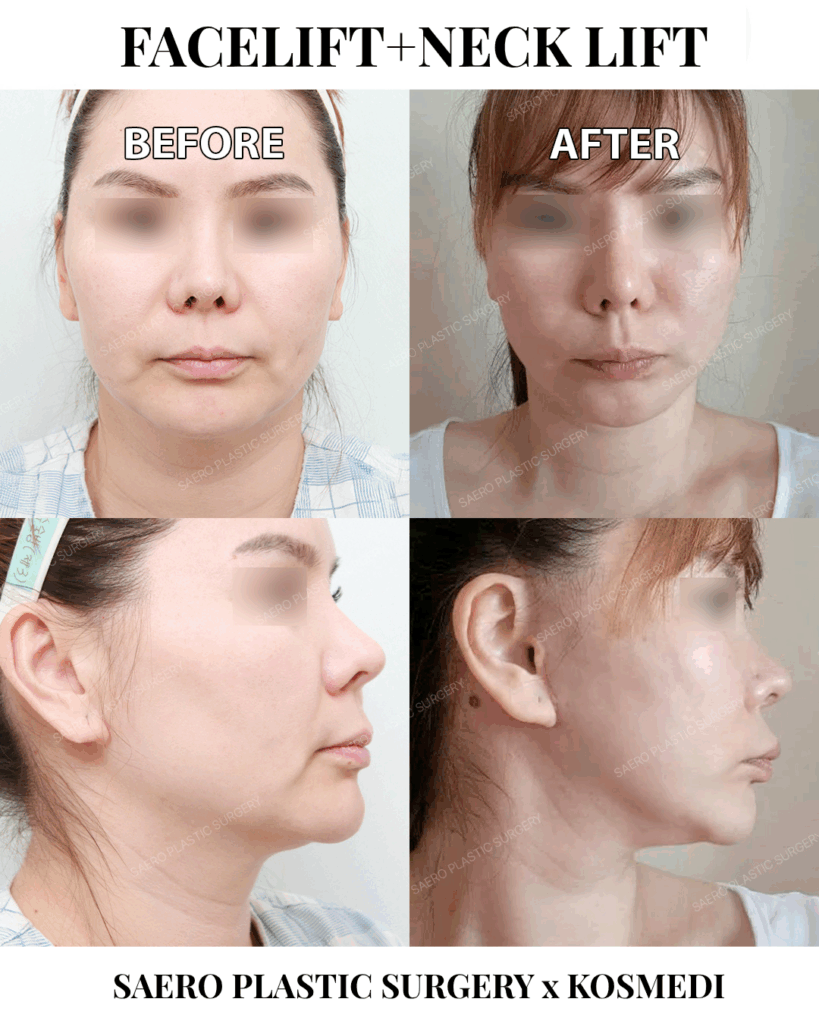
If you are comparing a deep plane facelift and an Endoscopic Facelift in Korea, the question most people care about first is simple: which one leaves less visible scarring? In general, an Endoscopic Facelift tends to involve smaller and more concealed incisions, often hidden in the hairline or other less visible areas, while a deep plane facelift usually requires longer incisions around the ears and hairline in order to lift deeper facial structures and address more advanced lower-face and neck laxity.
That does not mean one is automatically better than the other. The right choice depends on the area being treated, the degree of sagging, the patient’s skin quality, and the type of result they want.
Why Scar Concerns Matter in Facelift Surgery
Scar concerns are a major reason many patients hesitate before facelift surgery. People want visible rejuvenation, but they also want the result to look natural and not leave obvious signs of surgery.
Important concerns commonly include:
• Where the facelift incision is placed
• How visible the scar may be
• Which areas of the face each technique improves
• How long recovery may take
• Which patients are suitable for each technique
This is why the comparison between a deep plane facelift and an Endoscopic Facelift should not simply be viewed as “large scars versus small scars.” It is more useful to compare the extent of surgery, incision placement, facial areas treated, and the patient’s individual anatomy.
What Is an Endoscopic Facelift?
An Endoscopic Facelift is a lifting technique that uses an endoscope to allow the surgeon to directly view deeper anatomical structures while working through relatively small incisions.
At Saero Plastic Surgery, facelift surgery focuses on more than simply pulling the skin. The clinic explains that its approach works with the SMAS layer, the deeper supportive tissue layer located beneath the skin and fat.
The procedure is designed to carefully identify and reposition deeper tissues while using high-definition endoscopic visualization.
Important characteristics include:
• High-definition endoscopic visualization
• Smaller surgical access points
• More concealed incision placement
• Direct visualization of important anatomical structures
• SMAS layer repositioning
• Retaining ligament consideration
• Focus on natural-looking facial lifting
For patients worried about surgical scars, these smaller access points are one of the main reasons an Endoscopic Facelift may be attractive.
What Is a Deep Plane Facelift?
A deep plane facelift is a more extensive facial lifting technique that works underneath the SMAS layer and addresses deeper facial support structures.
It is commonly considered when facial aging involves more substantial tissue descent, particularly around the lower face, jawline, jowls, and neck.
A deep plane facelift may involve:
• Deeper tissue release
• Repositioning of facial support structures
• Correction of prominent jowls
• Lower-face rejuvenation
• Neck contour improvement
• Skin redraping when necessary
• Longer incisions compared with limited endoscopic approaches
Because more tissue may need to be repositioned and excess skin sometimes needs to be removed, the incision can extend around the ear and into the hairline.
Endoscopic Facelift vs Deep Plane Facelift: Which Leaves Less Scarring?
If the primary concern is visible scarring, an Endoscopic Facelift generally has an advantage because it can use smaller and more concealed incisions.
Endoscopic Facelift:
• Smaller incisions
• Incisions may be hidden within the hair-bearing scalp
• Less extensive visible incision lines
• More discreet surgical access
• Often attractive to patients highly concerned about scars
Deep Plane Facelift:
• Usually requires longer incisions
• Incisions may extend around the ear
• Incisions can extend toward the temporal or posterior hairline
• More skin redraping may be necessary
• Early scars may therefore be easier to notice
However, an Endoscopic Facelift should not be described as completely scarless. Every surgical incision can create a scar.
Likewise, a deep plane facelift does not automatically result in obvious scars. With appropriate incision placement, delicate closure, controlled tension, and proper post-operative care, facelift scars can become considerably less noticeable as healing progresses.
What Determines How Visible a Facelift Scar Becomes?
The surgical technique is only one factor affecting the final appearance of a scar.
Scar visibility may also depend on:
• Incision location
• Incision length
• Skin tension during closure
• Surgical technique
• Individual healing tendency
• Skin type
• Post-operative wound management
• Sun exposure during recovery
• Smoking
• Infection or inflammation
• Hypertrophic or keloid scar tendency
This means that choosing an Endoscopic Facelift simply because the incision is shorter does not guarantee an invisible scar. Individual healing and post-surgery management remain important.
Which Areas Can an Endoscopic Facelift Treat?
An Endoscopic Facelift can be particularly useful when the goal is repositioning facial tissues through smaller and more concealed access points.
Depending on the individual surgical plan, concerns may include:
• Midface descent
• Sagging cheek tissue
• Early jowling
• Facial tissue laxity
• Loss of youthful facial positioning
• Certain upper-face or temporal aging concerns
The exact treatment area depends heavily on the technique used by the surgeon. “Endoscopic facelift” is therefore not a single standardized operation performed identically for every patient.
Which Patients May Need a More Extensive Facelift?
A more extensive lifting approach may be considered when aging is more pronounced.
Examples may include:
• Significant jowls
• Pronounced lower-face sagging
• Considerable neck laxity
• Excess skin
• Heavy facial tissue descent
• Advanced facial aging
For these patients, minimizing incision length should not necessarily be the only priority. A smaller incision may not provide enough access to correct the actual anatomical problem.
This is why the best facelift technique should be selected according to anatomy rather than simply choosing whichever procedure sounds less invasive.
Why Saero Plastic Surgery Stands Out for Endoscopic Facelift in Korea
Saero Plastic Surgery emphasizes a patient-centered approach based on safety, precision, personalization, and natural-looking results.
The clinic highlights six major areas of its medical philosophy:
① Board-Certified Plastic Surgeon
② Personalized Plastic Surgery
③ Safe Procedures
④ Patient-Centered Care
⑤ CT Imaging & Aftercare
⑥ Natural Results
These principles can be particularly relevant for an Endoscopic Facelift because minimizing scars requires more than simply making a small incision. Surgical planning, anatomical understanding, tissue handling, closure technique, and recovery management all contribute to the final outcome.
Saero Plastic Surgery also provides an English-language version of its website, allowing international patients to review information about the clinic, surgeon, procedures, directions, consultations, and recovery before visiting Korea.
Meet Dr. Young Gyu Park
Dr. Young Gyu Park is introduced by Saero Plastic Surgery as a board-certified plastic surgeon with more than 20 years of plastic surgery experience.
His professional background includes memberships in several plastic and reconstructive surgery organizations, together with academic publications related to plastic surgery.
For facelift procedures, surgeon experience is especially important because the final scar and facial contour may depend on factors such as:
• Incision planning
• Understanding of facial anatomy
• Control of skin tension
• Deep tissue repositioning
• Retaining ligament dissection
• Preservation of nerves and blood vessels
• Wound closure technique
• Post-operative management
Saero Plastic Surgery describes its aesthetic goal as achieving natural beauty through balance and harmony rather than simply creating an aggressively tightened appearance.
Saero Plastic Surgery’s Endoscopic Facelift Approach
Saero Plastic Surgery describes its facelift surgery as an approach that works directly with the SMAS layer rather than merely tightening the skin surface.
The clinic emphasizes several technical features:
• More than 20 years of wrinkle improvement experience
• Precision dissection considering retaining ligaments
• Customized SMAS layer targeting
• Full HD / HD endoscopic visualization
• Minimal incision techniques
• Direct visualization of anatomical structures
• Reduced unnecessary tissue damage
• Focus on natural facial repositioning
The clinic explains that high-definition endoscopic equipment helps the surgeon directly observe anatomical structures while performing the procedure. Minimal incision techniques are intended to reduce incision size and visible scarring while limiting unnecessary tissue trauma.
Endoscopic Facelift Recovery at Saero Plastic Surgery
Recovery is another important part of choosing facelift surgery in Korea.
According to Saero Plastic Surgery’s facelift information:
• Operation time is approximately 1–2 hours
• Stitch removal is generally performed after approximately 10 days
• Sedation and local anesthesia may be used
• The stated recovery period is approximately 1–3 months
Recovery is different for every patient. Swelling, bruising, incision redness, tightness, and temporary changes in sensation can develop following surgery.
Saero Plastic Surgery also states that surgical results vary between individuals and that potential complications can include inflammation, bleeding, or nerve-related problems.
Why Post-Surgery Treatment Matters for Facelift Scars
Post-operative management is particularly important when patients are concerned about scars.
Saero Plastic Surgery emphasizes CT Imaging & Aftercare as one of the clinic’s major strengths and describes its approach as managing patients from surgery through recovery.
Post-operative care may involve monitoring factors such as:
• Incision healing
• Swelling
• Bruising
• Inflammation
• Wound condition
• Scar maturation
• Facial symmetry during recovery
Saero Plastic Surgery summarizes its facelift approach around accurate diagnosis, delicate surgery, and thorough post-operative care.
This is particularly relevant to scar-conscious patients because even technically well-positioned incisions require time and appropriate care to mature.
Is Endoscopic Facelift Better Than Deep Plane Facelift?
There is no universal answer.
An Endoscopic Facelift may be more attractive when:
• Smaller incisions are a major priority
• Scar concealment is especially important
• Facial aging is mild to moderate
• The patient has relatively good skin elasticity
• The targeted facial area can be adequately corrected endoscopically
A more extensive deep plane facelift may be more appropriate when:
• Jowls are pronounced
• Lower-face sagging is advanced
• Neck laxity is significant
• Excess skin needs to be managed
• Broader facial rejuvenation is required
The decision should therefore focus on whether the procedure can adequately correct the patient’s anatomy, not only on which procedure creates the shortest incision.
Why International Patients Consider Saero Plastic Surgery in Korea
For overseas patients researching an Endoscopic Facelift in Korea, communication and accessibility can be almost as important as surgical technique.
Saero Plastic Surgery offers several features useful for international visitors:
• English-language website
• International consultation options
• WhatsApp consultation
• Online booking
• English procedure information
• Clear surgeon information
• Post-operative care information
• Convenient Seoul location
Saero Plastic Surgery is located in Seocho-gu, Seoul, near Sinnonhyeon Station, making the clinic relatively accessible for patients staying in Seoul.
Deep Plane vs Endoscopic Facelift Scars: Key Points
If scarring is one of your biggest concerns when researching facelift surgery in Korea, remember these points:
• An Endoscopic Facelift generally uses smaller incisions.
• Endoscopic incisions can often be concealed within the hairline or other discreet locations.
• Deep plane facelift incisions are generally longer because more extensive surgical access may be required.
• A deep plane facelift may provide broader correction for advanced lower-face and neck aging.
• Endoscopic does not mean completely scarless.
• Deep plane facelift scars can also become discreet with proper surgical planning and healing.
• The final scar depends on both surgical technique and individual healing.
• Post-operative care is an important part of scar management.
• The procedure should be chosen according to facial anatomy rather than incision size alone.
Saero Plastic Surgery and Kosmedi
Saero Plastic Surgery is an official partner clinic of Kosmedi.
If you would like to learn more about Saero Plastic Surgery, compare facelift techniques, understand whether an Endoscopic Facelift may be suitable for your concerns, or arrange an appointment in Korea, Kosmedi can help with clinic information, communication, and appointment support.
• WhatsApp: +82 10 9948 7172 | https://wa.me/821099487172 (Click)
• Email: Kosmedisns@gmail.com
• LINE ID: kosmedi
• Instagram: @kosmedi.official | https://www.instagram.com/kosmedi.official/ (Click)
• X: @KosmediOfficial | https://x.com/KosmediOfficial (Click)

