



What Is Seolleongtang, One of Korea’s Most Traditional Beef Soups?
Seolleongtang is one of Korea’s best-known traditional soup dishes, made by simmering beef bones and various cuts of beef for a long period of time.
The traditional way to eat seolleongtang is with rice and beef in a milky-white broth, then season it yourself with chopped green onions and salt according to your preference.
Unlike many Korean dishes that are served with spicy seasoning already added, seolleongtang itself has a relatively mild flavor. This makes it approachable for international travelers who may not be comfortable with spicy Korean food.
Eating it together with kimchi and kkakdugi, or cubed radish kimchi, creates a balance between the mild soup and the brighter, slightly spicy flavor of fermented vegetables.
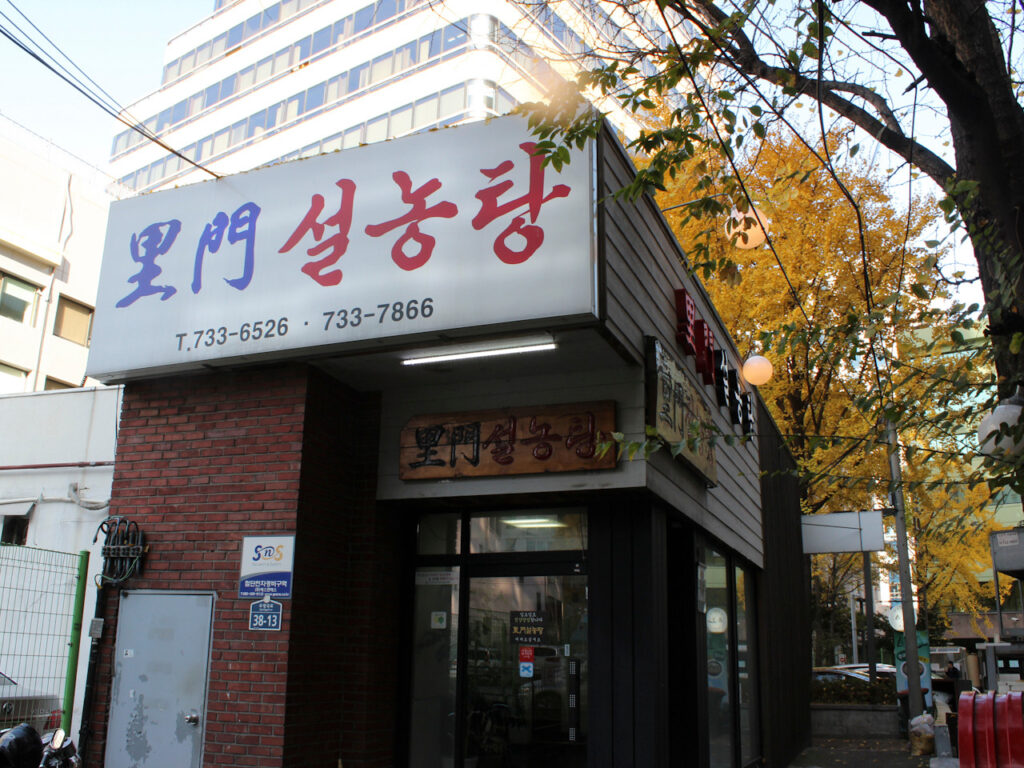
If you want to experience Seoul’s long-established seolleongtang culture, Imun Seolnongtang in Jongno is one of the most representative places to consider.
• Traditional Korean soup made with beef bones and meat
• Milky-white and mild broth
• Seasoned individually with green onions and salt
• Traditionally eaten with kimchi and kkakdugi
• Relatively approachable Korean food for travelers who do not eat spicy food
What Is the 100+ Year-Old Imun Seolnongtang?
Imun Seolnongtang is one of Seoul’s best-known long-established restaurants and has continued operating in Jongno for more than 100 years.
Seoul Future Heritage information explains that the restaurant began in 1904 when its founder opened a restaurant called “Imunok.”
Some Korea Tourism Organization materials list the opening year as 1907, so the exact founding year varies slightly depending on the official source.
However, the sources agree that Imun Seolnongtang has been operating since the early 1900s and represents more than a century of Seoul’s restaurant history.
Seoul Future Heritage also introduces the restaurant as one of Korea’s oldest operating restaurants and as a restaurant historically registered under Seoul City’s first restaurant license.
• More than 100 years of history dating back to the early 1900s
• One of Seoul’s best-known historic Korean restaurants
• Introduced as Seoul City’s first officially licensed restaurant
• Long-running family restaurant
• Representative traditional restaurant in Jongno
Imun Seolnongtang in the Michelin Guide Seoul 2026
Imun Seolnongtang is also listed in the Michelin Guide Seoul 2026.
The main attraction is not an elaborate or complicated menu. Instead, the Michelin Guide focuses on the traditional bowl of seolleongtang that has defined the restaurant for generations.
Beef bones are simmered in a large iron cauldron for approximately 17 hours, and the excess fat is carefully removed to create a broth that is milky in appearance yet relatively clean and mild in flavor.
Boiled beef dishes and seasoned boiled beef are also recognized as dishes worth trying alongside the restaurant’s signature soup.
This means that Imun Seolnongtang is known not only because of its long history, but also because it continues to serve a traditional style of Seoul seolleongtang today.
• Listed in the Michelin Guide Seoul 2026
• Beef-bone broth simmered for approximately 17 hours
• Excess fat removed for a cleaner finish
• Signature dish: traditional seolleongtang
• Boiled beef and seasoned boiled beef are also popular
Why Is Imun Seolnongtang Known as a Century Store?
Imun Seolnongtang is also recognized as a long-established Korean restaurant through the government’s Century Store program.
The Century Store designation recognizes businesses that have maintained their operations for at least 30 years while receiving consistent customer support and demonstrating long-term value and growth potential.
For a restaurant with more than a century of history, the meaning goes beyond simply being an “old restaurant.”
Imun Seolnongtang has experienced generations of change in Seoul’s dining culture while continuing to serve one of the city’s most traditional everyday foods.
Official Seoul tourism information also introduces it as a Century Store and one of the oldest restaurants still operating in Seoul.
• Government-recognized Century Store
• More than 100 years of restaurant history
• Restaurant that has experienced generations of Seoul food culture
• Good place to experience traditional Korean food in Jongno
• Popular with both local residents and travelers
Why Is the Broth at Imun Seolnongtang Milky Yet Clean-Tasting?
Seolleongtang may look extremely rich because of its milky-white color, but one of the defining characteristics of Imun Seolnongtang is the careful removal of excess fat during the long cooking process.
Seoul Future Heritage information explains that ingredients such as beef knee cartilage and bones are simmered for approximately 16 to 17 hours.
The restaurant also traditionally uses several different cuts of beef, including brisket, head meat, tongue, and other parts.
This produces a soup with a noticeable beef flavor while keeping the broth relatively mild rather than aggressively seasoned.
If you are visiting Imun Seolnongtang for the first time, it is better to taste the original broth before adding too much salt.
You can then gradually add chopped green onions and salt until the soup matches your preferred flavor.
• Beef bones and cartilage simmered for many hours
• Approximately 16–17 hours of broth preparation
• Excess fat removed for a cleaner taste
• Several different beef cuts used
• Season with green onions and salt according to personal preference
What Should First-Time Visitors Order at Imun Seolnongtang?
For a first visit to Imun Seolnongtang, the standard seolleongtang is the simplest place to begin.
The menu is centered around traditional beef soups and includes regular seolleongtang, special seolleongtang, Korean beef seolleongtang, doganitang, special doganitang, and head-meat soup.
If you want to experience a wider range of beef cuts, one of the special versions may be suitable.
If you enjoy the chewy texture of beef knee cartilage, doganitang is another option to consider.
Groups or visitors who want dishes to share with drinks can also consider Korean beef suyuk, dogani dishes, mixed boiled beef, beef head dishes, and seasoned suyuk.
Menu availability and composition can change, so checking the latest menu when visiting Imun Seolnongtang is recommended.
• Signature choice: Seolleongtang
• Special Seolleongtang
• Korean Beef Seolleongtang
• Doganitang and Special Doganitang
• Beef Head Soup
• Korean beef suyuk and other shared beef dishes
Why Is Rice Served Inside the Soup?
International visitors may be surprised to find rice already inside the soup at Imun Seolnongtang.
Some dishes follow a traditional Korean serving method known as toryeom, where rice is repeatedly warmed with hot broth before being served together.
This technique helps balance the temperature of the rice and soup and allows the grains to absorb some of the broth’s flavor.
Korean visitors often mention that receiving rice directly in the broth contributes to the atmosphere of eating at a traditional Seoul gukbap restaurant.
For international travelers, this serving style can also be an interesting introduction to Korea’s long-established soup-and-rice culture.
• Rice and soup served together
• Traditional toryeom preparation
• Rice absorbs the flavor and heat of the broth
• Typical Korean gukbap dining experience
• Opportunity to experience historic Seoul food culture
Should You Eat Kimchi and Kkakdugi with Imun Seolnongtang?
At a traditional seolleongtang restaurant, kimchi and kkakdugi can be almost as important as the soup itself.
Information about Imun Seolnongtang describes its kkakdugi as being prepared according to a long-established kitchen tradition.
After eating several spoonfuls of the mild broth, adding a bite of kimchi or cubed radish kimchi introduces acidity, spice, and a different texture.
Korean reviews also frequently mention the kimchi and kkakdugi alongside the soup itself.
Trying all three together is one of the easiest ways for international visitors to experience the traditional rhythm of a Korean seolleongtang meal.
• Kkakdugi pairs naturally with seolleongtang
• Traditional preparation style
• Adds acidity and spice to the mild broth
• Frequently mentioned in Korean visitor reviews
• Recommended as part of the complete seolleongtang experience
What Do Korean Visitors Say About Imun Seolnongtang on Naver?
Korean visitor reviews of Imun Seolnongtang often mention the experience of eating at a restaurant with such a long history, as well as the mild and savory broth, kimchi, and kkakdugi.
Some visitors say the soup initially tastes lightly seasoned, but becomes much more enjoyable after adding chopped green onions and a small amount of salt according to personal preference.
Reviews also mention that different beef cuts are included and that the meal is filling enough for breakfast, lunch, or dinner.
On the other hand, travelers who generally prefer strongly seasoned food may find the first taste relatively mild.
For that reason, Imun Seolnongtang may be particularly appealing to people who prefer the natural flavor of beef and broth rather than heavily seasoned soup.
• Mild and savory beef broth
• Adjust seasoning yourself with green onions and salt
• Positive comments about kimchi and kkakdugi
• Several beef cuts included
• Historic long-established restaurant atmosphere
• May initially feel mild for visitors who prefer stronger seasoning
What Do International Travelers Say About Imun Seolnongtang on Google?
Public Google-related review information shows that Imun Seolnongtang has accumulated thousands of reviews and maintains a rating in the 4-point range.
International visitors frequently mention that eating here feels like experiencing food that local Seoul residents have enjoyed for generations.
Although the broth looks very rich because of its milky appearance, overseas travelers often describe the actual flavor as softer, lighter, and more delicate than expected.
Some visitors say the combination becomes especially enjoyable when the soup is eaten together with kimchi and kkakdugi.
There are also international reviews describing Imun Seolnongtang as a comforting breakfast option or a particularly satisfying meal on a cold day in Seoul.
Because some overseas visitors initially find the broth under-seasoned, understanding that diners are expected to add salt and green onions themselves can make the experience easier to enjoy.
• Rated in the 4-point range on Google-based platforms
• Thousands of visitor reviews
• Opportunity to experience traditional local Seoul food
• Mild and smooth beef broth
• Kimchi and kkakdugi provide flavor contrast
• Suitable for breakfast and cold-weather meals
Can You Visit Imun Seolnongtang Alone?
Seolleongtang is one of Korea’s classic meals for solo dining, making Imun Seolnongtang relatively easy to visit even if you are traveling alone.
Each diner can order one individual bowl, and the meal does not require several shared dishes.
Public visitor experiences also mention solo seating and relatively quick meals even during busy daytime periods.
For groups, another approach is to order individual bowls of seolleongtang or doganitang and add boiled beef or seasoned boiled beef as shared dishes.
This makes the restaurant suitable for solo travelers, couples, families, and larger groups.
• Easy Korean meal for solo dining
• Individual bowls make ordering simple
• Suitable for relatively quick meals
• Groups can add shared boiled beef dishes
• Useful for breakfast, lunch, or dinner
Imun Seolnongtang Has Seating for Around 150 Guests
Imun Seolnongtang is described as having approximately 150 seats.
Visitors may imagine that a century-old restaurant in Jongno would be extremely small and narrow, but the restaurant is capable of accommodating a relatively large number of diners.
This makes it suitable not only for solo travelers but also for families and group dining.
However, because Imun Seolnongtang is one of the best-known traditional restaurants in Jongno, waiting can still occur during busy lunch periods, weekends, and peak travel seasons.
• Approximately 150 seats
• Suitable for family dining
• Can accommodate groups
• Appropriate for both solo and group visits
• Waiting may occur during peak periods
Where Is Imun Seolnongtang Located?
Imun Seolnongtang is located at 38-13 Ujeongguk-ro, Jongno-gu, Seoul, South Korea.
Its central Jongno location makes the restaurant convenient to visit from Jonggak Station, Insadong, and other major attractions in central Seoul.
The same address is also used by major official Seoul tourism and Michelin restaurant information.
This location makes it easy to combine a meal at Imun Seolnongtang with a walking itinerary through Jongno and Insadong or after visiting areas such as Gwanghwamun and Jogyesa Temple.
• Address: 38-13 Ujeongguk-ro, Jongno-gu, Seoul
• Located in central Jongno
• Close to Jonggak Station
• Convenient for an Insadong itinerary
• Good location for sightseeing in central Seoul
How to Get to Imun Seolnongtang from Jonggak Station
The easiest public transportation option for reaching Imun Seolnongtang is Seoul Subway Line 1.
Current map information places the restaurant approximately 266 meters from Jonggak Station Exit 3-1.
Official Seoul tourism information also identifies Jonggak Station Exit 3-1 as one of the closest subway access points.
After leaving the station, walk toward Ujeongguk-ro and follow the map into the smaller street where the restaurant is located.
Because Imun Seolnongtang is set slightly away from the main road, using a navigation app during your first visit can make the final approach easier.
• Seoul Subway Line 1
• Use Jonggak Station Exit 3-1
• Approximately 200–300 meters away
• Easy walking distance from the station
• Navigation app recommended for first-time visitors
Imun Seolnongtang Opening Hours and Break Time
The current operating hours for Imun Seolnongtang are from 8:00 AM to 9:00 PM from Monday through Saturday.
The restaurant has a break time from 3:00 PM to 4:30 PM.
The last order before the afternoon break is at 2:30 PM, while the evening last order from Monday through Saturday is at 8:30 PM.
On Sunday, Imun Seolnongtang operates from 8:00 AM to 8:00 PM, with the final evening order at 7:30 PM.
The restaurant may close early if ingredients sell out, so travelers planning a late visit should check the latest operating information before arriving.
• Monday–Saturday: 8:00 AM–9:00 PM
• Sunday: 8:00 AM–8:00 PM
• Break time: 3:00 PM–4:30 PM
• Lunch last order: 2:30 PM
• Monday–Saturday dinner last order: 8:30 PM
• Sunday dinner last order: 7:30 PM
• Early closing possible if ingredients sell out
Imun Seolnongtang Is Also a Good Breakfast Option in Seoul
Because Imun Seolnongtang opens at 8:00 AM, it can be useful for travelers looking for breakfast in central Seoul.
Seolleongtang contains warm broth, rice, and beef without relying on strongly spicy seasoning, making it relatively gentle as a morning meal.
International visitor reviews also describe the soup as warm and comforting for breakfast.
One practical itinerary is to eat at Imun Seolnongtang early in the morning and then begin a walking tour through Jongno, Insadong, Gwanghwamun, or nearby central Seoul attractions.
• Opens at 8:00 AM
• Breakfast available
• Mild and relatively gentle Korean meal
• Convenient before exploring Jongno and Insadong
• Particularly appealing during a winter trip to Seoul
Experience More Than 100 Years of Seoul Food History at Imun Seolnongtang
People visit Imun Seolnongtang for more than the fact that it is an old restaurant.
The long-simmered beef-bone broth, variety of beef cuts, self-seasoning with green onions and salt, and combination with kimchi and kkakdugi together represent a traditional form of Seoul-style seolleongtang.
The restaurant’s history and cultural value have also been recognized in several ways, including its Michelin Guide listing, Seoul Future Heritage status, and Century Store recognition.
For travelers who want something different from new, trendy, or highly stylized Korean food, Imun Seolnongtang offers an opportunity to experience a meal that has continued in Seoul for more than a century.
• More than 100 years of Seoul restaurant history
• Traditional seolleongtang preparation
• Michelin Guide listing
• Seoul Future Heritage
• Century Store recognition
• Good destination for experiencing long-established Korean food culture
Find Korean Medical and Local Travel Information with Kosmedi
Kosmedi (soon to become KormPath) is a service designed to help international travelers and foreign patients access Korean medical and travel information more conveniently.
Users can check information about hospitals reviewed by local Korean staff, whether confirmed interpretation services are available, medical procedures, health screenings, hospital events, and patient reviews.
Kosmedi also provides exclusive discount coupons and special events available only through the service, while questions related to hospitals and appointments can be addressed through real-time messaging support.
In addition to hospitals, Kosmedi introduces Korean local restaurants such as Imun Seolnongtang, as well as tourist attractions, festivals, discounts, events, popular destinations, and places frequently visited by local residents.
This allows international travelers to plan both Korean medical care and local travel experiences through the same service.
• Hospital information checked by local Korean staff
• Confirmed information about interpretation services
• Medical procedures, health screenings, hospital events, and reviews
• Kosmedi-exclusive discount coupons and events
• Real-time messaging support
• Korean restaurants, festivals, tourist attractions, and local travel information

