


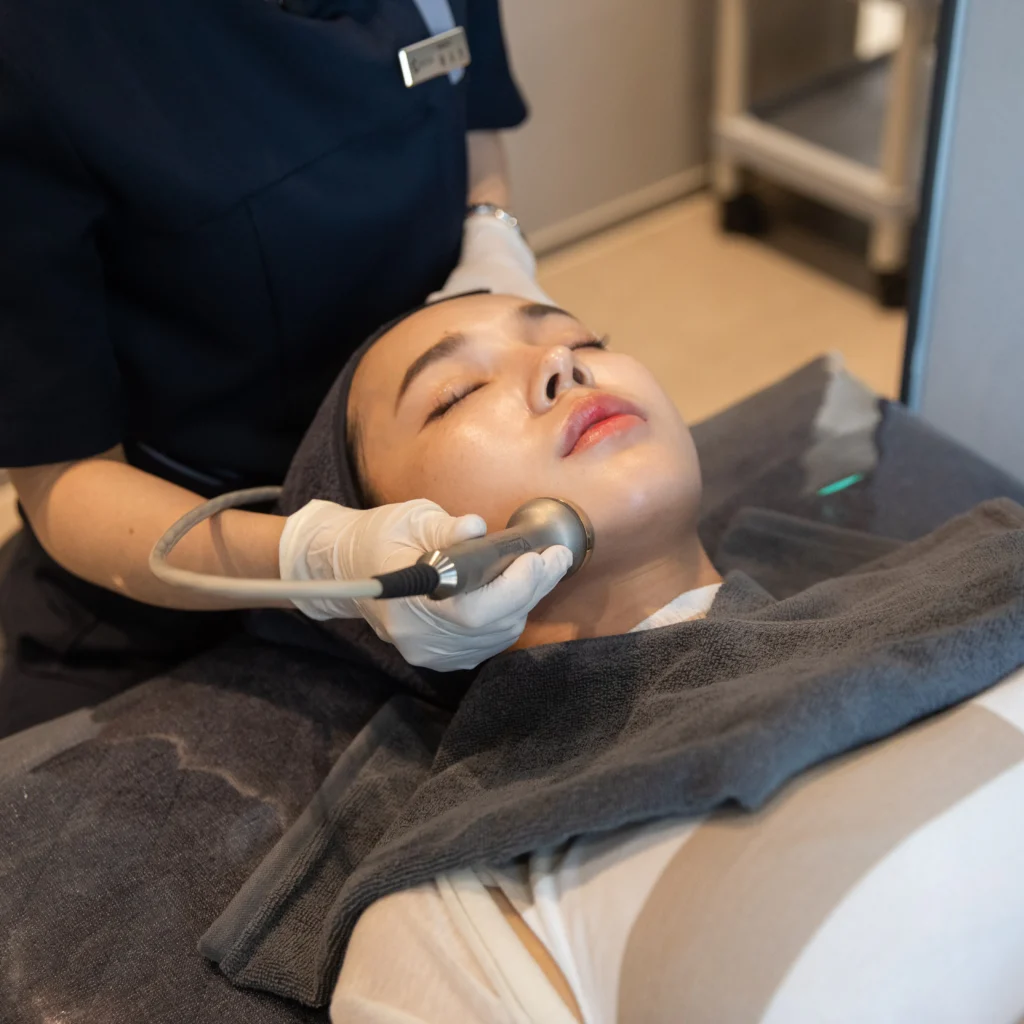
ODE Clinic Skin Treatment Photo
If you are comparing XERF vs Ultherapy in Korea, you are probably interested in three questions: Which treatment is better for skin tightening? Which one is less painful? And what kind of before-and-after change can you realistically expect?
Both treatments are commonly discussed under the broad category of non-surgical facial lifting, but they do not use the same technology. XERF uses monopolar radiofrequency (RF), while Ultherapy uses focused ultrasound energy. That difference affects how energy is delivered, which facial areas may be targeted, how the treatment feels, and how a doctor plans the procedure.
For patients researching skin tightening in Korea, ODE Clinic offers both technologies and has developed its own signature approach called DEEP MODE XERF. Rather than treating XERF as just another generic RF procedure, ODE Clinic focuses on using the device’s dual-frequency DEEP mode to deliver energy into different tissue depths.
XERF vs Ultherapy: What Is the Main Difference?
The biggest difference between XERF and Ultherapy is the type of energy they use.
XERF is a monopolar RF treatment using 6.78 MHz and 2 MHz frequencies. The dual-frequency system is designed to distribute thermal energy through different tissue depths.
Ultherapy, on the other hand, uses focused ultrasound energy. It also uses ultrasound visualization to help identify tissue layers and determine the appropriate treatment depth.
In simple terms:
• XERF = radiofrequency-based thermal treatment
• Ultherapy = focused ultrasound treatment
• Both can be used for non-surgical skin tightening and lifting
• The appropriate choice depends on facial anatomy, skin laxity, treatment area, and individual goals
This is why asking whether XERF is simply “better” than Ultherapy can be misleading. They use different technologies and may be suitable for different facial concerns.
What Is ODE Clinic’s DEEP MODE XERF?
DEEP MODE XERF at ODE Clinic is the clinic’s signature XERF treatment protocol.
XERF offers different energy-delivery modes, but ODE Clinic places particular emphasis on DEEP MODE, where the device uses both 6.78 MHz and 2 MHz frequencies.
The clinic explains that the two frequencies allow RF energy to be distributed through different tissue depths, making DEEP MODE particularly relevant for patients interested in broader facial tightening.
ODE Clinic also explains that performing treatment primarily in DEEP MODE can require more treatment time than a simpler protocol. The emphasis is therefore not merely on completing a fixed number of shots quickly, but on carefully delivering energy according to the patient’s facial structure and target areas.
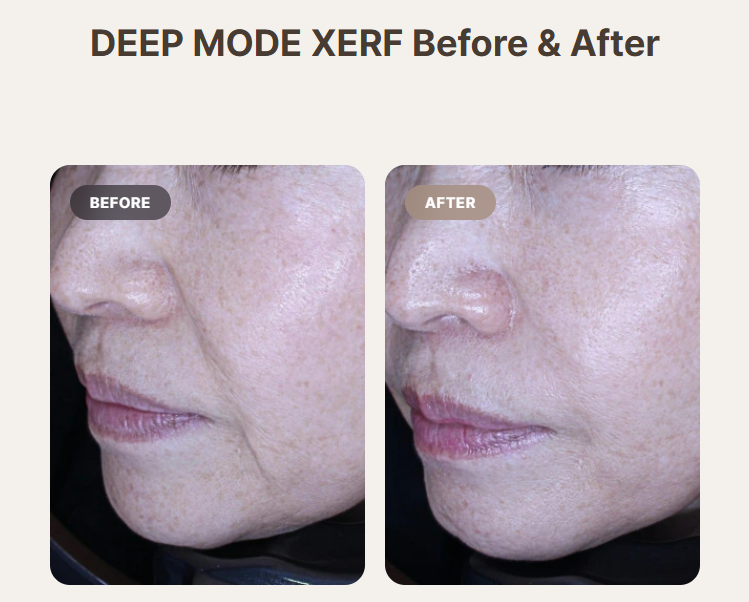
ODE Clinic Deep Mode Xerf Before & After Photo
Why Does XERF Use Two Frequencies?
One of the main characteristics of XERF is its use of 6.78 MHz and 2 MHz radiofrequency energy.
Different RF frequencies can affect how thermal energy is distributed within tissue. ODE Clinic’s DEEP MODE approach focuses on using both frequencies together rather than treating only more superficial tissue.
This approach may be considered for concerns such as:
• Reduced facial firmness
• Mild facial sagging
• Softening of the jawline
• Jowls
• Nasolabial fold appearance
• Sagging around the mouth
• General loss of facial elasticity
However, treatment suitability still depends on facial fat distribution, skin thickness, age, degree of laxity, and other anatomical factors.
XERF vs Ultherapy: Which One Hurts More?
Pain is one of the most common concerns when comparing XERF vs Ultherapy.
ODE Clinic describes XERF as generally more comfortable than Ultherapy in its own clinical comparison. The clinic estimates treatment discomfort at approximately 3–4 out of 10 for XERF and around 7 out of 10 for Ultherapy.
These numbers should not be treated as guaranteed pain scores because individual pain tolerance varies considerably.
XERF includes a cooling system designed to improve comfort while radiofrequency energy is delivered. This makes reduced procedural discomfort one of the reasons some patients become interested in XERF.
Ultherapy feels different because focused ultrasound energy is delivered to precise tissue depths. Patients may experience sensations such as heat, tingling, or brief discomfort during energy delivery.
For patients whose main priority is lower treatment discomfort, XERF may therefore be particularly attractive.
Why Can Ultherapy Feel Different From XERF?
The difference in sensation is partly caused by the way the two technologies deliver energy.
Ultherapy concentrates ultrasound energy at selected focal depths, while XERF distributes radiofrequency-generated thermal energy over a broader treatment area.
A patient’s experience may also depend on:
• Facial area being treated
• Energy level
• Number of treatment shots
• Tissue thickness
• Bone proximity
• Individual pain sensitivity
• Practitioner technique
This is why comparing device names alone does not provide the full picture. How the procedure is planned and performed also matters.
XERF vs Ultherapy: Which Areas Can Be Treated?
XERF and Ultherapy can both be used for facial tightening, but they may be selected differently depending on the area being treated.
XERF may be considered for concerns involving:
• Midface laxity
• Nasolabial fold appearance
• Jowls
• Jawline softness
• Mild lower-face sagging
• General skin firmness
Ultherapy may be considered for concerns involving:
• Jawline definition
• Under-chin laxity
• Neck laxity
• Selected deeper lifting areas
This does not mean each treatment can only be used in these areas. Treatment planning depends on individual anatomy and the physician’s assessment.
XERF Before and After: What Changes Should You Look For?
Before-and-after results for XERF skin tightening should not be compared with the dramatic tissue repositioning possible with surgical facelift procedures.
Non-surgical skin tightening generally aims for more gradual changes such as:
• Improved facial firmness
• Better jawline definition
• Reduced appearance of mild jowling
• Improved skin elasticity
• A slightly more lifted facial contour
• Improvement in selected folds associated with tissue laxity
ODE Clinic also uses 2D and 3D diagnostic imaging to help document changes before and after aesthetic treatments.
This can be useful because subtle lifting results can be difficult to evaluate accurately using memory alone.
Patients should remember that individual outcomes vary, and another person’s before-and-after result cannot predict exactly how their own face will respond.
When Do XERF Results Appear?
XERF results should not necessarily be judged only immediately after treatment.
Radiofrequency heating may create an early tightening sensation or appearance, while tissue remodeling can continue gradually afterward.
A useful before-and-after comparison may therefore include:
① Before treatment
② Immediately or shortly after treatment
③ Several weeks after treatment
④ Longer-term follow-up
The speed and degree of visible improvement depend on factors such as age, skin condition, facial laxity, treatment settings, and individual biological response.
Ultherapy Before and After: How Is It Different?
Ultherapy results also develop gradually.
Focused ultrasound energy is delivered into selected tissue layers, where it is intended to stimulate a biological response related to collagen remodeling and tissue tightening.
Some patients may experience temporary effects such as:
• Redness
• Slight swelling
• Tingling
• Tenderness
The difference between XERF and Ultherapy is therefore not simply that one produces immediate results while the other produces delayed results.
Both treatments involve biological changes that can continue after treatment.
The more meaningful difference is the type of energy used, how it is delivered, and which tissue levels are being targeted.
Does XERF Have Less Downtime Than Ultherapy?
ODE Clinic positions DEEP MODE XERF as a treatment designed to provide skin tightening with relatively minimal interruption to daily activities.
Temporary post-treatment effects may include:
• Warmth
• Mild redness
• Temporary tenderness
• Minor swelling
Ultherapy is also a non-surgical lifting treatment and generally does not require a long recovery period.
Temporary flushing, swelling, tingling, or tenderness may occur depending on the patient and treatment intensity.
For international patients receiving skin tightening in Korea, downtime can be particularly important because treatment often needs to fit around sightseeing, shopping, business schedules, or return flights.
Is XERF Better Than Ultherapy for Skin Tightening?
There is no universal answer.
XERF and Ultherapy work through different forms of energy, so neither treatment should automatically be considered better for every patient.
XERF may appeal to patients who want:
• Broad RF-based skin tightening
• Treatment of midface and lower-face concerns
• Lower concern about procedural pain
• Minimal interruption to daily activities
• Improvement in skin firmness and facial contour
Ultherapy may appeal to patients who want:
• Focused ultrasound treatment
• Treatment at selected tissue depths
• Ultrasound visualization during treatment planning
• Focused treatment of selected lifting areas
The better question is not simply “Which device is better?” but “Which treatment better matches my facial anatomy and main concern?”
Can XERF and Ultherapy Be Used Together?
Because XERF and Ultherapy deliver energy differently, some patients may discuss combination treatment rather than choosing only one device.
XERF distributes RF-generated thermal energy, while Ultherapy delivers focused ultrasound energy at selected depths.
However, more treatments do not automatically produce better results.
Combination treatment planning should consider:
• Degree of skin laxity
• Facial fat distribution
• Skin thickness
• Previous lifting procedures
• Facial volume
• Age
• Treatment intervals
• Desired result
• Pain sensitivity
ODE Clinic offers both XERF and Ultherapy, which allows patients to discuss different technologies rather than being limited to only one lifting device.
Why Choose ODE Clinic for XERF in Korea?
ODE Clinic is a Seoul aesthetic clinic with a strong focus on energy-based lifting and individualized treatment planning.
One of the clinic’s notable strengths is its access to multiple lifting technologies, including XERF and Ultherapy.
ODE Clinic emphasizes several aspects of its treatment approach:
• Direct medical consultation for personalized treatment planning
• Multiple energy-based lifting technologies
• 2D and 3D diagnostic photography
• Treatment planning based on individual skin condition
• Signature DEEP MODE XERF protocol
• Extensive experience with XERF treatments
• English-language website access for international visitors
ODE Clinic has also stated that it ranked among the clinics with a high XERF treatment volume in Korea.
For international patients researching XERF in Korea, access to both XERF and Ultherapy can be useful because different options can be discussed during the same consultation.
What Makes ODE Clinic’s DEEP MODE XERF Different?
ODE Clinic’s distinguishing point is not simply that the clinic has a XERF device.
The clinic emphasizes how the technology is used.
Its signature treatment focuses on DEEP MODE, which uses XERF’s characteristic 6.78 MHz + 2 MHz dual-frequency combination.
This is important because clinics using the same device may not necessarily use identical:
• Treatment modes
• Energy settings
• Shot distribution
• Treatment duration
• Target areas
• Treatment patterns
The device itself is therefore only one part of the treatment. Physician assessment and treatment planning can also influence the experience and outcome.
ODE Clinic Before and After Evaluation
Before-and-after evaluation is particularly important for non-surgical lifting because changes may be relatively subtle.
Differences in lighting, camera angle, facial expression, and head position can make casual comparison unreliable.
ODE Clinic uses 2D and 3D skin diagnostic systems as part of its aesthetic assessment process, which can help provide more consistent documentation before and after treatment.
This can make it easier to evaluate gradual changes in:
• Facial contour
• Jawline appearance
• Skin firmness
• Mild jowling
• Overall facial balance
Individual results still vary, and standardized photographs should be considered a method of documentation rather than a guarantee of a particular result.
XERF in Korea for International Patients
Korea is a popular destination for international visitors researching non-surgical lifting and skin tightening treatments.
One advantage of receiving treatment in Korea is that clinics may provide several categories and generations of lifting technologies within the same facility.
Before choosing a treatment, international patients should consider:
① What is causing my facial sagging?
② Is my concern mainly skin laxity, facial fat, or volume loss?
③ Which facial area needs treatment?
④ How much discomfort am I comfortable with?
⑤ How much downtime can I allow during my Korea trip?
⑥ When should I evaluate my before-and-after result?
⑦ Would XERF, Ultherapy, or another approach better match my concerns?
ODE Clinic also provides an English-language option on its website, making it easier for overseas patients to review treatment information before visiting Korea.
XERF vs Ultherapy: Pain, Results and Differences at a Glance
XERF
• Monopolar radiofrequency treatment
• Uses 6.78 MHz and 2 MHz frequencies
• Broad thermal energy delivery
• ODE Clinic focuses on DEEP MODE
• Often described as more comfortable than focused ultrasound
• Designed with minimal downtime in mind
• May be considered for skin firmness and selected facial contour concerns
Ultherapy
• Focused ultrasound technology
• Energy delivered to selected tissue depths
• Uses real-time ultrasound visualization
• Commonly used for non-surgical lifting
• Treatment sensation may include heat or tingling
• Often considered for jawline, under-chin, and neck concerns
Neither treatment is automatically the right choice for every patient.
What Do People Commonly Compare When Searching XERF vs Ultherapy?
People researching XERF vs Ultherapy commonly compare several factors before selecting a treatment.
The most common comparison points include:
• Radiofrequency vs focused ultrasound
• Treatment pain
• Treatment areas
• Expected downtime
• Before-and-after results
• Time required for results to develop
• Facial lifting versus overall skin firmness
• Suitability for different facial anatomy
These questions are especially relevant for international patients who may have limited time in Korea and want to choose a treatment before or shortly after arriving in Seoul.
XERF vs Ultherapy in Korea: Which Treatment Should You Choose?
If your biggest concern is pain, XERF may be attractive because ODE Clinic describes it as generally more comfortable than Ultherapy.
If your primary goal is skin tightening, both technologies may be relevant, but they achieve treatment through different energy mechanisms.
If your concerns include the midface, nasolabial folds, jowls, jawline, and broader facial firmness, ODE Clinic may discuss XERF as one possible treatment.
If your main concern is focused lifting around the jawline, under the chin, or selected deeper tissue areas, Ultherapy may also be considered.
Ultimately, selecting a treatment based only on online popularity is not ideal. A consultation can help determine whether the dominant issue is skin laxity, facial volume, facial fat distribution, skin quality, or a combination of concerns.
XERF vs Ultherapy: Key Points to Remember
• XERF uses radiofrequency, while Ultherapy uses focused ultrasound.
• XERF is not a laser treatment.
• XERF uses 6.78 MHz and 2 MHz frequencies.
• ODE Clinic’s signature protocol focuses on DEEP MODE XERF.
• ODE Clinic describes XERF as generally less painful than Ultherapy.
• Individual pain tolerance varies considerably.
• Both treatments may improve selected forms of facial laxity without surgery.
• Before-and-after results should be evaluated over time rather than only immediately after treatment.
• ODE Clinic uses 2D and 3D diagnostic imaging to support before-and-after evaluation.
• XERF and Ultherapy target tissue differently and should not be considered identical treatments.
• The appropriate treatment depends on facial anatomy, skin condition, treatment area, and individual goals.
ODE Clinic and Kosmedi
ODE Clinic is an official partner clinic of Kosmedi. If you are considering XERF, DEEP MODE XERF, Ultherapy, or another skin tightening treatment in Korea, Kosmedi can help you learn more about ODE Clinic, communicate with the clinic, compare available treatment options, and arrange an appointment.
If you have questions about XERF vs Ultherapy, treatment pain, before-and-after expectations, or skin tightening in Korea, feel free to leave a comment or submit your inquiry using the form below.
• WhatsApp: +82 10 9948 7172 | https://wa.me/821099487172 (Click)
• Email: Kosmedisns@gmail.com
• LINE ID: kosmedi
• Instagram: @kosmedi.official | https://www.instagram.com/kosmedi.official/ (Click)
• X: @KosmediOfficial | https://x.com/KosmediOfficial (Click)

