



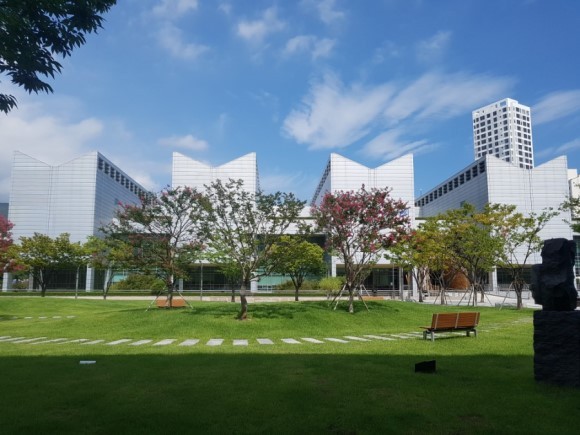
Busan Museum of Art Official Website (Kor/Eng)
Discover the History of Busan Art at Busan Museum of Art
Busan has developed a distinctive art history shaped by its identity as a major port city, its role as Korea’s temporary wartime capital during the Korean War, international exchange, cinema, and contemporary art culture.
Within Busan’s art community, there had long been discussions about the need for a public museum dedicated to researching and exhibiting regional art. Against this background, Busan Museum of Art officially opened in March 1998.
Since opening, Busan Museum of Art has expanded from exhibitions examining Busan artists and regional art history to Korean and international contemporary art, moving images, installations, archival exhibitions, education, research, and cultural programs. In 2015, the museum also opened Lee Ufan Space, a dedicated venue where visitors can experience the work of internationally recognized Korean artist Lee Ufan.
More recently, Busan Museum of Art completed an approximately two-year major renovation and reopened on September 17, 2026. Exhibition galleries, storage facilities, entrances, and visitor amenities were upgraded, allowing the museum to return as one of Busan’s key destinations for experiencing contemporary art.
• Opened in March 1998
• Major public art museum representing Busan
• Covers both Busan regional art history and contemporary art
• Presents exhibitions by Korean and international artists
• Lee Ufan Space opened in 2015
• Reopened on September 17, 2026 after approximately two years of renovation
• Convenient cultural destination to combine with Haeundae and BEXCO
What Changed After the 2026 Reopening?
Busan Museum of Art underwent a major renovation to modernize aging facilities and create an environment capable of presenting a wider range of contemporary art.
The renovation improved exhibition galleries and collection storage facilities, upgraded temperature and humidity control systems, and expanded visitor amenities such as a café and cultural retail spaces. Access from the BEXCO side was also improved, making the museum more convenient for visitors arriving by public transportation.
The reopened museum does not focus on a single flagship exhibition. Instead, Busan Museum of Art presents several exhibitions simultaneously, covering Korean history and society, the institution’s own history, children and families, and questions about the future of museums.
• Improved exhibition gallery structure
• Expanded collection storage facilities
• Upgraded temperature and humidity control systems
• Expanded café and visitor amenities
• Improved BEXCO-side entrance access
• Multiple exhibitions available during one visit
• Expanded role as a contemporary public art museum
Major Exhibitions Currently at Busan Museum of Art
As of October 2026, several exhibitions that opened with the reopening of Busan Museum of Art are running at the same time.
Major exhibitions include But We Are Still on the High Waves of This Sea: 1945–1953, which explores modern Korean history; Future Museology, which examines the future of museums; To All the Museums of Yesterday, which looks back at the history of Busan Museum of Art; and Safe Base, an exhibition that is also approachable for children and families.
The permanent exhibition at Lee Ufan Space can also be visited, allowing travelers to experience Korean contemporary art, modern Korean history, and museum archives within a single museum trip.
• But We Are Still on the High Waves of This Sea: 1945–1953
• Future Museology
• To All the Museums of Yesterday
• Safe Base
• Lee Ufan Space permanent exhibition
• Exhibition closing dates vary, so check the schedule before visiting
But We Are Still on the High Waves of This Sea: 1945–1953
One of the most notable current exhibitions at Busan Museum of Art is But We Are Still on the High Waves of This Sea: 1945–1953.
The exhibition examines how Korean society was formed from the period immediately following liberation from Japanese colonial rule through the Korean War and its aftermath, using both artworks and documentary materials.
Along with works from the Busan Museum of Art collection, the exhibition brings together approximately 250 artworks and around 450 archival materials held by major Korean art museums, museums, artists, artists’ families, and private collectors.
Rather than simply presenting art produced between 1945 and 1953 in chronological order, the exhibition allows visitors to consider how liberation, division, war, and rapid social change affected individuals and artists, while also connecting historical perspectives with interpretations by contemporary artists.
• Exhibition period: September 17, 2026–February 14, 2027
• Venue: Main Building, 2nd-floor galleries
• Approximately 250 artworks
• Approximately 450 archival materials
• Examines the formation of Korean society after liberation
• Explores social changes before, during, and after the Korean War
A Meaningful Korean Modern History Exhibition for International Visitors
For international travelers visiting Korea for the first time, But We Are Still on the High Waves of This Sea at Busan Museum of Art can offer more than a conventional art museum experience.
The period extending from Korea’s liberation in 1945 through the Korean War in 1950 and the social transformations that followed provides important historical context for understanding contemporary Korean society and cities.
Busan itself has particular significance because it served as Korea’s temporary wartime capital during the Korean War. Viewing the exhibition in Busan can therefore provide additional historical context. Travelers can also combine the museum with historical sites in downtown Busan to better understand the social circumstances represented in the artworks.
• Helpful introduction to Korean society between 1945 and 1953
• Explores liberation and changes surrounding the Korean War
• Connects with Busan’s history as the wartime capital
• Recommended for international visitors interested in modern Korean history
• Combines artworks with historical and archival materials
Free Exhibition Docent Tours
Visitors who want a deeper understanding of the exhibition can take advantage of the docent program at Busan Museum of Art.
For But We Are Still on the High Waves of This Sea: 1945–1953, docent tours are offered at scheduled times without separate advance reservations. Visitors can gather in front of the exhibition entrance before the tour begins.
Because the exhibition contains a large number of artworks and archival documents, joining a guided explanation can be particularly useful for visitors who are unfamiliar with Korean modern history.
• Tuesday–Friday: 2:10 PM
• Saturday–Sunday: 11:10 AM and 2:10 PM
• No separate advance reservation required
• Meet in front of the exhibition entrance
• Useful for understanding both the artworks and their historical context
Future Museology and the Future of Art Museums
Future Museology explores the direction of the newly reopened Busan Museum of Art and asks what role museums may play in the future.
The renovation was not approached only as a project to replace aging facilities. It also became an opportunity to reconsider how technology, society, nature, audiences, and art can establish new relationships within a public museum.
The 2026 reopening reflects this direction, examining how public museums may develop through contemporary art and international museum networks.
• Exhibition period: September 17, 2026–March 14, 2027
• Focuses on the future of museums
• Explores relationships between art, society, and technology
• Connects with international museum collaboration
• Recommended for visitors interested in contemporary art and museum studies
To All the Museums of Yesterday: Exploring the Museum’s History
To All the Museums of Yesterday looks back at the history of Busan Museum of Art from the perspective of the newly reopened institution.
The exhibition examines demands within Busan’s art community for a municipal art museum from the 1960s, the museum’s development process during the 1990s, and changes that took place after its official opening in 1998.
Travelers interested in how Busan developed as a cultural city can use the exhibition to understand the relationship between the city, local artists, and the public museum.
• Exhibition period: September 17, 2026–March 14, 2027
• Venue: Main Building, 2nd-floor Project Gallery
• Introduces the development of Busan Museum of Art
• Examines the relationship between local artists and a public museum
• Shows how the institution has changed since 1998
Safe Base for Children and Families
Families traveling in Busan can also visit Safe Base at Busan Museum of Art.
Following the reopening, the museum has expanded programs and gallery content for children and teenagers, helping it function as a space that families can enjoy together rather than as a museum designed primarily for adult contemporary-art audiences.
Safe Base is currently scheduled to continue through May 2027, making it a possible indoor family destination during winter and spring trips to Busan.
• Exhibition: Safe Base
• Period: September 17, 2026–May 30, 2027
• Suitable for children and families
• Children’s art programs available
• Useful as an indoor family attraction in Busan
Visit Lee Ufan Space Together with the Main Museum
If you visit Busan Museum of Art, it is worth exploring Lee Ufan Space instead of leaving after seeing only the main building.
Opened in 2015, Lee Ufan Space is a dedicated exhibition venue centered on works by Lee Ufan, one of Korea’s internationally recognized contemporary artists.
Compared with a conventional museum filled with many works, the space is especially suited to slower viewing that focuses on relationships between artworks, architecture, empty space, materials, and the surrounding environment. This creates a very different experience from the museum’s larger thematic exhibitions.
• Opened in 2015
• Dedicated to works by Lee Ufan
• Calm atmosphere different from the main exhibition building
• Recommended for visitors who enjoy slow contemporary art viewing
• Can be visited together with the main museum
Busan Museum of Art Admission | Temporarily Free
Busan Museum of Art is currently offering temporary free admission. Both the main museum and Lee Ufan Space are presently available without an admission charge.
Under the museum’s standard admission structure, paid admission normally applies, including a regular individual adult admission price of KRW 5,000 for the main museum. However, temporary free admission is currently being offered during the reopening period, allowing visitors to experience several exhibitions without additional admission costs.
The free-admission policy may change in the future, so travelers visiting at a later date should confirm the latest admission information before arriving.
• Current admission: Temporarily free
• Main museum: Currently free
• Lee Ufan Space: Currently free
• Standard paid admission may return in the future
• Check the latest admission information before visiting
Busan Museum of Art Opening Hours and Closed Days
Busan Museum of Art, the Children’s Gallery, and Lee Ufan Space are generally open from Tuesday through Sunday.
The main museum closes at 6:00 PM, with final admission at 5:00 PM. Lee Ufan Space is also open until 6:00 PM, with final admission at 5:30 PM. Current operating hours are 10:00 AM to 6:00 PM.
Monday is the regular closed day. If Monday falls on a public holiday, the museum is closed on the following day instead.
• Monday: Closed
• Tuesday: 10:00 AM–6:00 PM
• Wednesday: 10:00 AM–6:00 PM
• Thursday: 10:00 AM–6:00 PM
• Friday: 10:00 AM–6:00 PM
• Saturday: 10:00 AM–6:00 PM
• Sunday: 10:00 AM–6:00 PM
• Main museum last admission: 5:00 PM
• Lee Ufan Space last admission: 5:30 PM
• Closed on January 1
• If Monday is a public holiday, the museum closes the following day
How Much Time Should You Allow for Your First Visit?
Because several exhibitions are running at the same time and Lee Ufan Space can also be visited, it is better to allow enough time at Busan Museum of Art rather than planning only a quick photo stop.
Travelers focusing on one or two major exhibitions can allow approximately one to two hours. Those who want to explore several reopening exhibitions and Lee Ufan Space more carefully may prefer two to three hours or even half a day.
Recent visitor feedback also notes that the exhibitions vary considerably in theme and atmosphere, meaning there can be more to see than expected even if visitors select only a few exhibitions.
• Major exhibitions only: approximately 1–2 hours
• Multiple exhibitions: approximately 2–3 hours recommended
• Consider half a day for detailed viewing including Lee Ufan Space
• Allow extra time if joining a docent tour
• Comfortable walking shoes recommended
Official Website Supports English
International visitors can use the English version of the official Busan Museum of Art website.
The English pages are useful for checking exhibition schedules, opening hours, visitor information, and basic museum details when Korean is difficult to read.
However, international visitor feedback indicates that although major exhibitions often include English information, not every archival document or detailed exhibition text may be fully translated. Travelers who want to understand historically complex exhibitions in greater depth may therefore find it helpful to use the official English information together with translation tools.
• Official English-language website available
• International visitors can check exhibition schedules and visitor information
• English information is available for many major exhibitions and artworks
• Detailed archival materials may have more limited English translation
• Reviewing basic historical context before visiting can improve the experience
What Korean Visitors Commonly Mention in Naver Map Reviews
Korean visitors frequently mention that Busan Museum of Art feels brighter and cleaner following the renovation, with spacious galleries, corridors, and circulation areas.
Because several exhibitions with different themes are presented simultaneously, visitors who are not deeply familiar with contemporary art can choose exhibitions that match their interests. The museum is also often considered a practical indoor destination in Busan when the weather is rainy, hot, or otherwise unsuitable for outdoor sightseeing.
The location near BEXCO and Centum City is another advantage frequently mentioned by visitors planning a larger sightseeing itinerary.
• Bright and clean environment after renovation
• Multiple exhibitions available in one location
• Spacious corridors and circulation areas
• Useful indoor attraction in Busan
• Different exhibition themes make it easy to choose what interests you
• Convenient to combine with BEXCO and Centum City
What Do International Visitors Mention in Google Map Reviews?
International visitors to Busan Museum of Art often describe the museum as quiet and calm, making it suitable for slowly viewing contemporary art.
Its proximity to BEXCO and Centum City is also frequently seen as an advantage because the museum can easily be included in a broader day of sightseeing, shopping, or cultural activities.
Some international visitors mention that certain galleries may occasionally close during exhibition changeover periods and that English descriptions are not available for every document or detailed archive item.
For that reason, international travelers may want to check the exhibitions and currently open galleries on the official website before visiting.
• Quiet and calm museum atmosphere
• Suitable for slowly viewing contemporary art
• Convenient location near BEXCO and Centum City
• Amount of English information may vary by exhibition
• Some spaces may close during exhibition changeovers
• Check current exhibitions before visiting
Busan Museum of Art Location
Busan Museum of Art is located at 58 APEC-ro, Haeundae-gu, Busan.
The museum is in the Haeundae and Centum City area, close to BEXCO. Instead of visiting only the museum, travelers can easily combine it with BEXCO events, Shinsegae Centum City, Busan Cinema Center, and other nearby attractions.
• Address: 58 APEC-ro, Haeundae-gu, Busan
• Located in the Haeundae and Centum City area
• Close to BEXCO
• Easy to combine with Shinsegae Centum City
• Convenient for eastern Busan travel itineraries
Busan Museum of Art Naver Map
Busan Museum of Art Google Map
How to Get to Busan Museum of Art from BEXCO Station
The easiest way to reach Busan Museum of Art is by Busan Metro Line 2.
Get off at BEXCO Station, also marked as BEXCO (Busan Museum of Art), and use Exit 5. Depending on the route information source, the museum is approximately 100 to 260 meters from the station and can easily be reached on foot.
Because the station name itself references the museum, this is one of the easiest transportation options for international travelers visiting Busan for the first time.
• Subway: Busan Metro Line 2
• Station: BEXCO (Busan Museum of Art) Station
• Recommended exit: Exit 5
• Approximately 3–5 minutes on foot
• Simplest public transportation option
How to Get to Busan Museum of Art by Bus
Travelers can also reach Busan Museum of Art by getting off at either the BEXCO bus stop or the Olympic Intersection bus stop.
Many routes serve the area, making buses useful when traveling from Haeundae, Gwangalli, or other parts of Busan. However, first-time international travelers may find Busan Metro Line 2 easier to understand.
• BEXCO bus stop: 31, 39, 40, 63, 100, 100-1, 115-1, 141, 181, 200, 307
• Olympic Intersection bus stop: 31, 39, 40, 63, 100, 100-1, 115-1, 141, 181, 200, 1001
• Subway recommended for first-time visitors
How to Get to Busan Museum of Art from Busan Station
Travelers starting from Busan Station can reach Busan Museum of Art by combining subway and local public transportation.
In the provided route example, traveling from the Busan Station area toward BEXCO Station takes approximately 49 minutes, with an estimated transportation fare of around KRW 1,800.
Actual travel time may vary depending on transfer waiting times and traffic conditions, so allowing some additional travel time is recommended.
• Starting point: Busan Station
• Estimated journey: approximately 49 minutes
• Estimated fare: approximately KRW 1,800
• Get off near BEXCO Station and walk to the museum
• Easy to connect a Busan Station arrival with a cultural sightseeing itinerary
How to Get to Busan Museum of Art from Busan Seobu Intercity Bus Terminal
From Busan Seobu Intercity Bus Terminal, travelers can use Sasang Station and Busan Metro Line 2 to reach Busan Museum of Art.
According to the provided route information, the total journey takes approximately 51 minutes, with an estimated fare of around KRW 1,800.
The route mainly uses Line 2 and does not require complicated transfers, making it relatively easy to understand for travelers arriving in western Busan.
• Starting point: Busan Seobu Intercity Bus Terminal
• Take Line 2 from Sasang Station
• Get off at BEXCO Station
• Estimated journey: approximately 51 minutes
• Estimated fare: approximately KRW 1,800
How to Get to Busan Museum of Art from Busan Central Bus Terminal
Travelers starting from Busan Central Bus Terminal can reach Busan Museum of Art by connecting Busan Metro Lines 1, 3, and 2.
The provided route begins at Nopo Station, transfers at Yeonsan Station and Suyeong Station, and ends at BEXCO Station. The estimated journey is approximately 54 minutes, with a fare of around KRW 1,800.
Because the route involves two transfers, travelers carrying large suitcases may want to allow additional time.
• Starting point: Busan Central Bus Terminal
• Take Line 1 from Nopo Station
• Transfer to Line 3 at Yeonsan Station
• Transfer to Line 2 at Suyeong Station
• Get off at BEXCO Station
• Estimated journey: approximately 54 minutes
• Estimated fare: approximately KRW 1,800
Why Busan Museum of Art Works Well with a Centum City and BEXCO Itinerary
One major advantage of Busan Museum of Art is the concentration of cultural, shopping, and entertainment facilities nearby.
BEXCO, Shinsegae Centum City, and Busan Cinema Center are all close, making it possible to visit the museum in the morning and spend the afternoon shopping in Centum City or exploring additional cultural attractions before continuing toward Haeundae.
The area is also useful for building an indoor-focused Busan itinerary on rainy days or when outdoor sightseeing conditions are poor.
• Located next to BEXCO
• Easy to combine with Shinsegae Centum City
• Busan Cinema Center is nearby
• Convenient connection to Haeundae sightseeing
• Useful indoor attraction on rainy days
Who Should Visit Busan Museum of Art?
Busan Museum of Art is particularly suitable for travelers who want to spend time understanding exhibition themes and spaces rather than simply seeing a few famous artworks as quickly as possible.
Visitors interested in Korean modern and contemporary history, Busan regional art, contemporary art, museum architecture, cultural institutions, or Lee Ufan can compare several different types of exhibitions in one location.
With temporary free admission currently available, Busan Museum of Art is also easy to add to a Haeundae or Centum City itinerary without creating a significant additional travel cost.
• Travelers interested in Korean contemporary art
• Visitors who want to explore Korean modern history through art
• Travelers interested in Busan regional art history
• Visitors interested in Lee Ufan
• Travelers looking for an indoor attraction on rainy days
• Visitors combining BEXCO and Centum City with a cultural itinerary
Discover Korean Hospitals, Exhibitions, and Busan Travel Information with Kosmedi
Kosmedi helps international travelers and foreign patients access practical medical and travel information in Korea more conveniently.
Kosmedi introduces hospitals checked by local Korean staff and medical institutions where the availability of interpretation services has been confirmed. Visitors can immediately review information about dermatology, plastic surgery, health checkups, and other medical services, including procedures, prices, special events, patient reviews, and detailed hospital introductions.
For Kosmedi partner hospitals and clinics, international visitors can also check whether Kosmedi-exclusive discount coupons and special events are available. Before traveling to Korea or while staying in the country, users can access real-time messaging consultation to ask questions about hospital reservations and medical services.
Kosmedi is not limited to hospital information. The service also introduces Korean museums and exhibitions that are useful for international visitors, including Busan Museum of Art, as well as restaurants, cafés, festivals, pop-up stores, tourist attractions, discount events, popular destinations, and local places frequently visited by Korean residents.
From foreign patients combining medical appointments with travel in Busan to general international visitors who want to experience Korean art and regional culture, Kosmedi helps users find both medical and tourism information in one place.
• Hospital information checked by local Korean staff
• Medical institutions with confirmed interpretation services
• Procedure, health checkup, price, event, and patient review information
• Kosmedi-exclusive discount coupons and special events
• Real-time messaging consultation
• Korean museum and exhibition information
• Restaurant and café recommendations
• Festival, pop-up store, and tourist attraction information
• Discount event and popular destination information
• Local destinations frequently visited by Korean residents

